How Do You Choose Event Production for a Small Business?
Last Updated: November 10, 2026
Quick Summary
Choose event production for a small business by deciding first whether your team can own the technical work, then matching core services like sound, lighting, staging, and crew to your event type. Vet at least three companies on experience, gear, crew, communication, and price, and compare itemized proposals on the same scope rather than the bottom line alone.
- Event planning covers venue, guests, catering, and schedule; event production covers sound, lighting, staging, video, power, and crew.
- Sound, lighting, staging, crew, and contingency gear are core services; video, projection, and backline are add-ons.
- Hybrid is the most common fit for small businesses: you handle logistics, a partner owns the technical core.
- Budget 10-15% contingency, and spend on audio first, lighting second, and video third.
- Ask whether crew hours, backup equipment, and travel are included before comparing quotes.
Table of Contents
- Why Small Businesses Need a Production Partner, Not Just Rentals
- Event Planning vs. Event Production: What's the Difference?
- Event Production Services for Small Businesses: What You Actually Need
- Building a Realistic Production Budget
- Questions to Ask an Event Production Company Before You Sign
- Your Event Production Checklist for Vetting and Booking
- Comparing Proposals and Protecting Yourself in the Contract
- Book a Free Walkthrough and Evaluation with AudioBahn Productions
- Frequently Asked Questions
Why Small Businesses Need a Production Partner, Not Just Rentals
Picking event production for small businesses is less about gear and more about who owns the outcome. There are 36,207,130 small businesses in the United States, according to the Small Business Administration's 2026 small business FAQ, and most of them run events with a team of one or two people.
Here is the part most guides get wrong. A rental company delivers boxes. A production partner owns the sound check, the backup plan, and the moment the wireless mic dies during the keynote.
Below, we break down how to vet a production company, what services you actually need, and where the budget really goes.
Event Planning vs. Event Production: What's the Difference?
Event planning is the logistics of why people gather. Event production is the technical and creative work that makes the gathering work.
Think of it this way:
- Planning: venue, guest list, invitations, catering, schedule, budget
- Production: sound, lighting, staging, video, power, crew, backup gear
- Planning asks: who is coming and why?
Small teams often try to do both. That works for a 30-person luncheon. It falls apart the moment you add a stage, a speaker program, or live entertainment. For a closer look at how production fits smaller corporate events, see our guide to production services for small corporate events.
Event Production Services for Small Businesses: What You Actually Need
Event production services for small businesses break into two tiers: core services you cannot run without, and add-ons that improve the experience. You can review the full range of event production services to match them to your event needs.
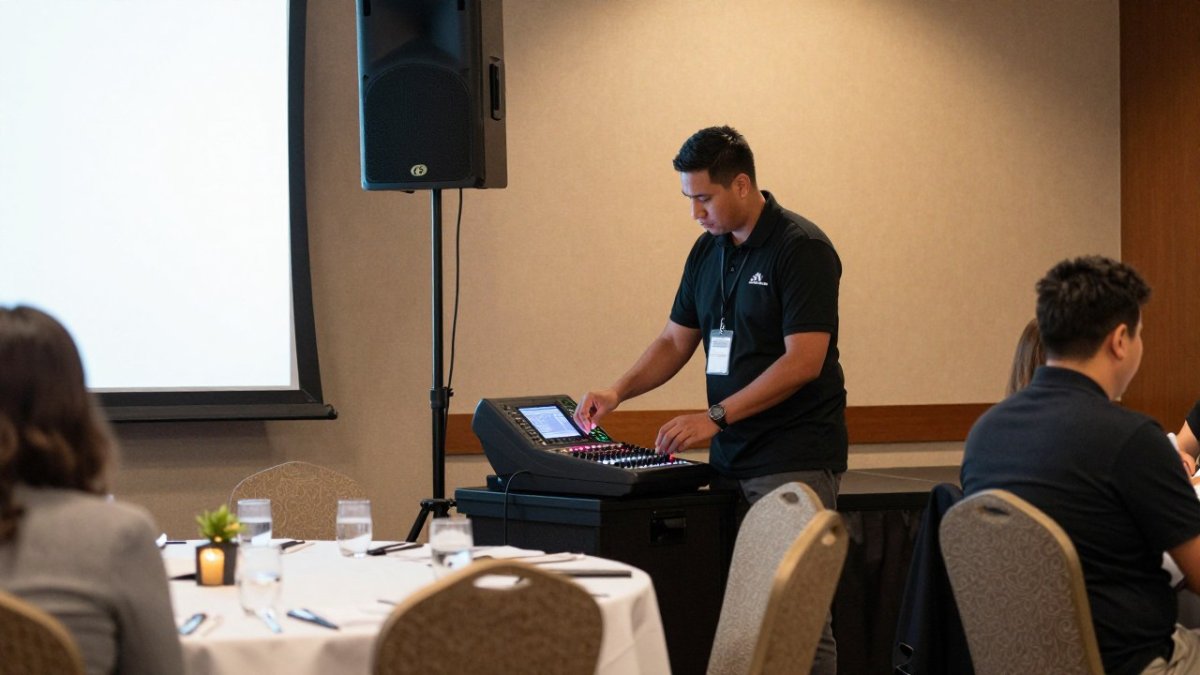
Core services vs. add-ons
| Service | Core or Add-On | What It Covers |
|---|---|---|
| Sound reinforcement | Core | Mics, speakers, mixing, playback |
| Stage lighting | Core | Wash, spot, and ambient light for the room |
| Staging and risers | Core | Safe, level platform for speakers or performers |
| Video and projection | Add-on | Screens, IMAG, slides, recording |
| Backline | Add-on | Instruments and amps for live music |
| Crew and labor | Core | Load-in, show call, load-out |
| Contingency gear | Core | Backup mics, cables, and power |
If your event has a speaker program, sound and lighting are not optional. If it has a band, backline and staging move to core. Match the list to your event type before you ask for quotes.
Building a Realistic Production Budget
The budget question trips up most first-time buyers. Pricing depends on room size, crew hours, gear count, and travel, so a quote is best made after reviewing the space. What you can do is build a budget framework before you ever request a quote, so every proposal you receive is measured against the same yardstick.
Start with these line items:
- Gear rental and labor
- Delivery, setup, and strike time
- Power and rigging needs
The DIY, hybrid, and full-service decision
Before you price anything, decide which production tasks your team can realistically own. This single decision moves your budget more than any negotiation tactic.
- DIY: You rent gear and run it yourselves. This works for small luncheons, simple presentations, and events where the audience is close and the room is forgiving. It fails when you add a stage, a speaker program, or live entertainment, because someone has to mix audio, run lighting cues, and troubleshoot mid-show, and that person cannot also greet guests.
- Hybrid: You handle planning and logistics, and you bring in a production partner for the technical core, sound, lighting, staging, and crew. This is the most common fit for small businesses because it keeps your team focused on guests while a professional owns the show call.
- Full-service: A production partner owns the technical scope end to end, including load-in, show call, and load-out. This makes sense when the event carries real stakes, a product launch, a client-facing conference, or anything with press or executives on stage.
A practical rule: if a technical failure would be visible to your guests and you do not have a dedicated technician on your team, hybrid or full-service is worth the expense. If the event is small, informal, and low-stakes, DIY can work, but budget for backup gear and extra setup time.
Where to spend and where to save
Spend on the things the audience notices: clear audio, even lighting, and a stage that looks intentional.
A common pattern among small businesses is to overspend on video and underspend on audio.
Watch out: cutting crew hours to save money is the most common budget mistake we see. Load-in and sound check need real time, and rushing them shows up on stage.
Comparing quotes when the budget is tight
When you have three proposals in hand, do not compare the bottom line alone. Compare what each quote actually delivers per dollar:
- Does the quote include crew hours for load-in, show call, and load-out, or are those billed separately?
- Is backup equipment included, or is it an add-on?
- Are travel and delivery charges itemized?
A lower quote that excludes crew hours or backup gear is not actually lower, it is incomplete. Ask each vendor to re-quote on the same scope so you are comparing like for like.
Coordinating multiple vendors on a tight budget adds its own risk. Our guide on coordinating multiple event vendors covers how to keep handoffs clean.
Questions to Ask an Event Production Company Before You Sign
The right questions separate a production partner from a delivery service. Ask these before you compare proposals:
- Have you produced events at our scale and event type?
- Can we see a portfolio and case studies from similar shows?
- Who is the lead technician on show day, and will they be at load-in?
- What is your backup plan if a mic, mixer, or lighting console fails?
- Does your proposal list every line item, including labor and travel?
- Who handles power, rigging, and venue coordination?
- What is your response time if something breaks mid-show?
- What does your contract say about cancellations, insurance, and payment terms?
Case studies carry real weight here. Research in the Journal of Social Research on case study analysis shows case studies offer in-depth analysis of organizational success that general marketing claims cannot match. Ask for the show, not the brochure.
For a deeper question list, use our guide on what to ask event production companies.
Your Event Production Checklist for Vetting and Booking
Run this checklist in order. Each step filters out weak vendors before you spend time on a proposal.
- Define event goals, audience size, and must-have moments
- Confirm venue capabilities and limitations, including power and load-in access
- Decide your service tier: DIY, hybrid, or full-service
That scorecard matters more than gut feel. A vendor with great gear and poor communication will still leave you guessing on show day.
Comparing Proposals and Protecting Yourself in the Contract
Read every proposal line by line. A good one tells you exactly what arrives, who sets it up, and what happens if plans change. The contract behind that proposal is where financial risk lives, and small businesses are more exposed than large ones because a single surprise charge can wipe out the event's value.
Compare on these points:
- Itemized gear list versus a lump-sum package
- Crew count and hours included
- Load-in and strike windows
Deposits and payment schedules
A deposit reserves your date and crew, so most production companies require one. The safeguard is not avoiding a deposit, it is understanding what triggers the next payment and what happens if the event changes. Ask whether payments are tied to milestones (contract signing, site walkthrough, show date) or to calendar dates, and confirm whether any portion is refundable. A payment schedule that front-loads most of the cost before load-in gives you little leverage if the vendor underdelivers.
Cancellation and rescheduling terms
Cancellation policies vary widely, and the terms that matter are the ones that apply to your situation. Ask specifically:
- What happens if you cancel 30 days out versus 7 days out?
- Can you reschedule to a new date without losing the deposit?
- What happens if the venue cancels or changes the date?
A common pattern is a sliding scale where the refund shrinks as the event date approaches. That is reasonable, but get the scale in writing before you sign.
Liability, insurance, and equipment responsibility
Ask for a certificate of insurance and confirm the coverage limits match your venue's requirements. Venues often require vendors to carry general liability coverage and to name the venue as an additional insured, if the production company cannot provide that, your event may be blocked at load-in.
Equipment responsibility runs both directions. Confirm who is responsible if gear is damaged during the event, your guests, your venue, or the vendor's own crew. If your team is handling any equipment, ask whether the contract assigns liability to you for damage or loss.
Scope changes and change orders
Scope changes are where budgets quietly break. Adding a speaker, extending the run time, or requesting an extra screen after the contract is signed usually triggers a change order with additional cost.
Watch out: vague scope-of-work language is where disputes start. If the proposal says "sound system" without a gear list, ask for specifics before you sign.
The event industry keeps shifting toward hybrid formats to stretch limited budgets, according to the U.S. Chamber of Commerce on hybrid event models.
Book a Free Walkthrough and Evaluation with AudioBahn Productions
Choosing event production for small businesses comes down to one question: who is accountable when the show starts?
We built AudioBahn Productions around that answer. We handle scheduling, payments, and contract administration so you have one point of contact, not five.
Ready to see what your event actually needs? Get a free quote and tell us about your show.
Stop guessing whether your room, power, and gear will hold up on show day.
Frequently Asked Questions
What should a small business look for in an event production company?
Look for experience with events at your scale, not just large concerts. Ask for case studies from similar corporate events, confirm the company carries liability insurance, and check that the proposal lists every piece of audio-visual equipment, lighting, and staging by model. A production partner should also assign one point of contact for scheduling, payments, and contract administration, so nothing falls through the cracks between vendors.
What is the difference between event planning and event production?
Event planning covers the overall concept, venue selection, guest list, catering, and timeline. Event production handles the technical build: sound, lighting, staging, backline, and the crew that runs it during the show. Small businesses often need both, but they are separate scopes. Knowing which one you are hiring for keeps your budget honest and prevents gaps on event day.
How do you compare event production companies for a small event?
Use a simple scorecard: experience with your event type and scale, portfolio and references, equipment list and technical specs, insurance and contract terms, communication style, and total cost including labor and logistics. Score each vendor on the same criteria, then weigh the categories that matter most to your event. The cheapest quote often excludes labor, delivery, or backup equipment, so compare line by line.
How far in advance should you hire an event production company?
For a small corporate event or party, start conversations four to eight weeks out. Larger events with staging, lighting design, and multiple vendors need two to three months. Peak seasons fill up faster, so book earlier if your date falls near holidays or graduation. Early booking also gives you time for a site walkthrough, equipment checks, and a rehearsal with your volunteer or in-house tech crew.

Sound, lighting, staging and LED video. Free quote.
Frequently Asked Questions
What should a small business look for in an event production company?
Look for experience with events at your scale, not just large concerts. Ask for case studies from similar corporate events, confirm the company carries liability insurance, and check that the proposal lists every piece of audio-visual equipment, lighting, and staging by model. A production partner should also assign one point of contact for scheduling, payments, and contract administration, so nothing falls through the cracks between vendors.
What is the difference between event planning and event production?
Event planning covers the overall concept, venue selection, guest list, catering, and timeline. Event production handles the technical build: sound, lighting, staging, backline, and the crew that runs it during the show. Small businesses often need both, but they are separate scopes. Knowing which one you are hiring for keeps your budget honest and prevents gaps on event day.
How do you compare event production companies for a small event?
Use a simple scorecard: experience with your event type and scale, portfolio and references, equipment list and technical specs, insurance and contract terms, communication style, and total cost including labor and logistics. Score each vendor on the same criteria, then weigh the categories that matter most to your event. The cheapest quote often excludes labor, delivery, or backup equipment, so compare line by line.
How far in advance should you hire an event production company?
For a small corporate event or party, start conversations four to eight weeks out. Larger events with staging, lighting design, and multiple vendors need two to three months. Peak seasons fill up faster, so book earlier if your date falls near holidays or graduation. Early booking also gives you time for a site walkthrough, equipment checks, and a rehearsal with your volunteer or in-house tech crew.