What to Ask Event Production Companies: A Guide
Last Updated: November 1, 2026
Quick Summary
Ask event production companies about scope and staffing, backup equipment and insurance, show-day troubleshooting, and post-event follow-through. Get the equipment list, crew headcount by role, cancellation and change-order terms, and a named show caller in writing before you sign. Vague answers are a finding, not a neutral gap.
- Ask every question out loud and note whether each answer is specific or vague.
- Request the equipment list in writing with model numbers and quantities.
- Confirm insurance coverage, cancellation policy, and change-order terms before signing.
- Schedule a site visit four to eight weeks out to check power, access, and rigging points.
- Ask for two or three references from events similar in size and venue type, then call them.
Table of Contents
- Why the Right Questions Separate a Smooth Show From a Stressful One
- Questions to Ask an Event Production Company Before You Sign
- Your Event Production Company Checklist, Organized by Project Stage
- Reading an Event Production Proposal Checklist Line by Line
- Building a Realistic Event Production Timeline
- How to Compare Proposals on an Apples-to-Apples Basis
- Red Flags and the Questions That Surface Them
- Register Your Event and Start the Walkthrough
- Frequently Asked Questions
Why the Right Questions Separate a Smooth Show From a Stressful One
The questions you ask event production companies before signing a contract determine whether your show runs on a written plan or on improvisation. Planners often discover gaps in scope, staffing, and backup coverage only after load-in has already started.
A production partner touches nearly every part of your event: audio, lighting, staging, video, crew, and the schedule that ties them together. Reviewing our event production services shows exactly what we offer so you can frame your questions around real capabilities.
Below, we break down exactly what to ask, how to read the answers, and how to compare proposals without getting lost in formatting. We also flag the red flags that should end a conversation.
Questions to Ask an Event Production Company Before You Sign
The best questions to ask an event production company fall into four groups: scope and staffing, backup and contracts, show-day execution, and post-event follow-through. Most planners ask only the first group and sign. The other three tell you what happens when the room, the schedule, or the gear does not cooperate.
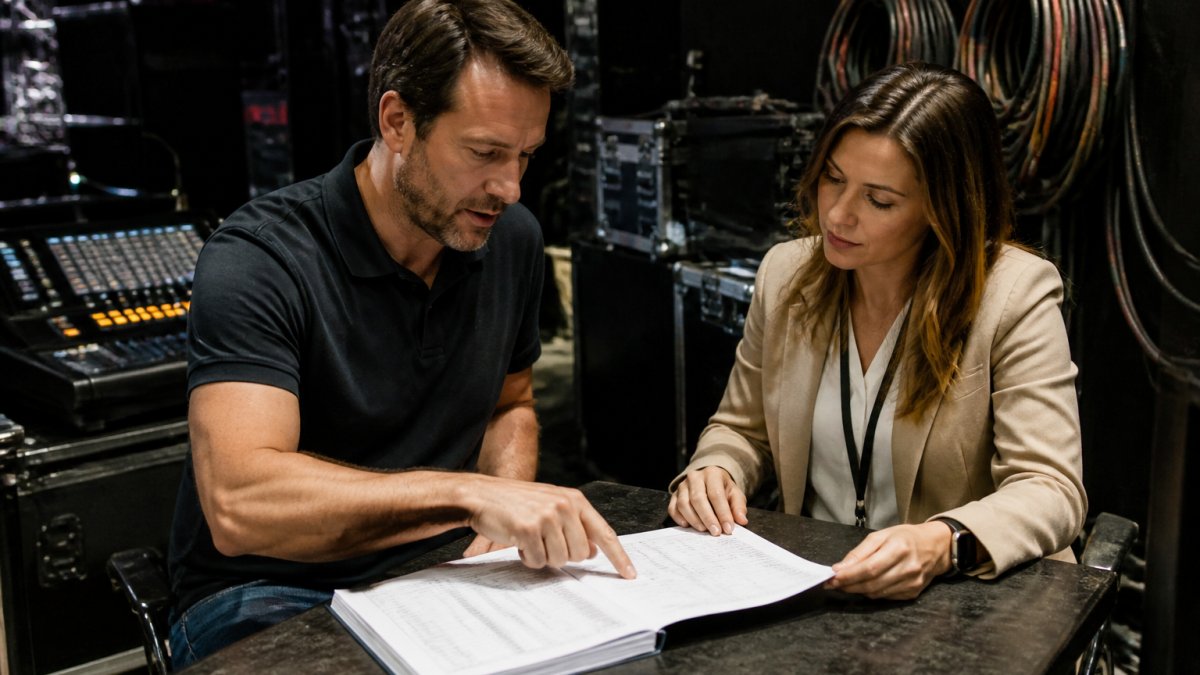
Use this as an interview script. For broader context on what to ask, see this guide to hiring professional event production.
Scope, Staffing, and Technical Capabilities
Start with what is actually included. A common mistake is assuming "full production" covers everything on your list.
- Which services are in scope, and which are subcontracted? Ask for the subcontractor names and who manages them.
- Who is the show caller, and will that person be on site for load-in, rehearsal, and show?
- How many crew members will you provide, and what are their roles? Get a headcount by role, not a total.
- Can you provide equipment specs and model numbers in advance? Ask for the written list, not a verbal summary.
- Have you worked this venue before, and what did you learn? Ask about power, rigging points, load-in path, and noise limits.
- What is your service area, and how far will you travel for this event? Confirm travel and lodging are in the quote.
- Do you handle logistics beyond AV, tents, restrooms, power distribution, fencing, or other live-event support? If not, who coordinates those vendors?
- For church or volunteer-run systems, do you offer training for volunteer tech crews, and is it included or separate?
Ask for the equipment list in writing. Vague answers about "professional gear" tell you nothing about whether the system matches your room. If the company offers a free walkthrough and evaluation of your existing system, schedule it before you compare proposals.
Backup Plans, Insurance, and Contracts
This is where most planners stop asking too early. A production company that cannot explain its contingency plan in plain language does not have one.
- What backup equipment comes on site, and who decides when to swap it in? Ask for the spare list by category: console, wireless, amplifiers, lighting fixtures, cabling.
- What are your insurance and liability coverage terms? Ask for a certificate of insurance and confirm the coverage limits in writing.
- How do change orders work, and who approves them? Ask who signs, how quickly, and whether labor and gear are billed at the same rate as the original quote.
Show-Day Execution and Troubleshooting
These questions separate a company that plans from one that improvises.
- Who is the on-site lead, and what is their cell number for the day?
- What is the troubleshooting chain if a wireless mic drops, a fixture fails, or the video feed freezes?
- How do you handle a schedule slip, who decides to cut a segment or extend a break?
Post-Event Follow-Through
- Will we get a post-event report or debrief, and when?
- Who returns calls after the invoice is paid?
- Can you share references from events similar in size and venue type?
Ask for two or three references and actually call them.
Your Event Production Company Checklist, Organized by Project Stage
An event production company checklist works best when it follows the project's actual stages rather than a flat list of questions. Use it as a working document and update it at each milestone.
| Stage | What to Confirm | When |
|---|---|---|
| First contact | Services offered, service area, event size range | Before the first call |
| Site visit | Venue access, power, rigging points, load-in path | 4-8 weeks out |
| Proposal review | Line-item scope, crew count, equipment list | After the site visit |
| Contract | Insurance, cancellation, change orders, payment schedule | Before signing |
| Planning | Run of show, show flow, vendor coordination | 2-4 weeks out |
| Show week | Load-in schedule, technical rehearsal, backup plan | Days before |
| Event day | Show caller, troubleshooting contacts, teardown plan | On site |
| Post-event | Reporting, client feedback, equipment return | Within a week |
Print it, share it, and check items off. The checklist helps turn a plan into action.
Reading an Event Production Proposal Checklist Line by Line
An event production proposal checklist is only useful if you read it line by line instead of skimming the total. Most proposals bury the details that matter in the middle.
Look for these items first:
- Labor hours and crew count. Confirm how many hands are on site.
- Equipment models and quantities. Confirm the gear matches your room and audience size.
- Load-in and load-out windows. These should match your venue contract.
Use the checklist above to sanity-check any proposal you receive, including ours. For help interpreting line items and budget expectations, see this live event technical support pricing guidance.
Building a Realistic Event Production Timeline
A realistic event production timeline starts with the venue's access rules and works backward. Most planners build it forward and then discover the load-in window is too short. The fix is a backward plan with named buffers, not a list of dates.
Step 1: Anchor on the Venue Contract
Pull three numbers from the venue contract before you plan anything else: the earliest load-in time, the latest load-out time, and any restriction on noise, rigging, or power. These three numbers set the outer walls of your schedule. If the venue will not confirm them in writing, get them confirmed before you approve a production proposal.
Step 2: Work Backward Through These Milestones
- Event date and venue contract signed. Everything else depends on this.
- Site visit completed. Confirm power, access, rigging points, load-in path, and any elevator or door limits. Schedule this four to eight weeks out for most events.
- Proposal approved and contract signed. Lock in crew and gear. Confirm the show caller and crew headcount in writing.
- Run of show drafted. Share it with every vendor, not just production. A run of show that only production has seen is not a plan.
- Technical rehearsal scheduled. Leave a buffer between rehearsal and doors. A common pattern is to schedule rehearsal the same day as the show with no buffer; if it runs long, the show pays for it.
- Load-in and setup. Build in a buffer sized to the venue, not a generic hour count. A room with a long load-in path or a freight elevator needs more buffer than a ground-floor ballroom.
- Show operation and teardown. Confirm the load-out deadline in writing and assign someone to enforce it.
Step 3: Size the Buffers Deliberately
Buffers are not padding; they are the schedule's shock absorbers. Set them where the risk is highest:
- Load-in buffer: add time for the venue's access quirks, not just the gear count.
- Rehearsal buffer: add time for troubleshooting wireless, video, and lighting cues.
- Show buffer: build in a short cushion between segments so a slip in one does not cascade.
Step 4: Plan for the Milestones That Slip
Milestones slip. The question is whether the schedule absorbs the slip or breaks. Decide in advance what gives: which segment can be shortened, which cue can be simplified, and who has authority to make that call on site. Put that decision in the run of show so the show caller is not improvising at doors.
A timeline that names its buffers and its fallback decisions is the difference between a plan and a wish list.
How to Compare Proposals on an Apples-to-Apples Basis
Comparing proposals fairly means normalizing them before you compare totals. Two quotes with different scopes are not comparable, no matter what the bottom line says.
Build a simple comparison sheet with these rows:
| Comparison Row | Proposal A | Proposal B | Proposal C |
|---|---|---|---|
| Crew count and roles | |||
| Equipment models listed | |||
| Backup gear included | |||
| Site visit completed | |||
| Load-in/load-out hours | |||
| Insurance and liability | |||
| Change-order terms | |||
| Exclusions |
Fill it in from the written proposals only. If a vendor left a row blank, mark it as missing rather than assuming. Missing information is a finding, not a neutral gap.
Red Flags and the Questions That Surface Them
Red flags in event production usually appear as vague answers. Push on each one before you move forward.
- No site visit offered. Ask why. A company that skips the venue cannot plan around its limits.
- No named show caller. Ask who will run the show and whether they will be on site.
- No written equipment list. Ask for model numbers and quantities.
If a company cannot explain its emergency support commitments, ask for them in writing before you sign. This guide to emergency audio visual technical support helps you judge whether those commitments are credible.
Register Your Event and Start the Walkthrough
The best way to evaluate a production partner is to watch how they handle your actual event. We offer a free walkthrough and evaluation of your system, and we recommend needed upgrades only.
We handle concert sound, stage lighting, staging, backline, and equipment rentals, plus scheduling, payments, and contract administration. When you are ready to talk specifics, request a quote and tell us about your event.
Frequently Asked Questions
What should I ask an event production company before hiring them?
Start with scope: which services they handle in-house versus through subcontractors, who serves as show caller, and what crew arrives on site. Ask for a written contingency plan covering backup equipment and response times if gear fails mid-show. Request a certificate of insurance and review the contract for cancellation terms and change-order procedures. Finally, ask for references from events similar in size and venue type to yours, then actually call them.
What do event production companies actually do?
Event production companies handle the technical and logistical backbone of a live event: audio, lighting, video, staging, and backline, plus crew, show flow, load-in, and teardown. Many also coordinate vendors and manage the run of show on event day. The scope varies widely, so confirm in writing whether your partner supplies equipment only or full production management, including a show caller and technical rehearsal.
How far in advance should I book an event production company?
For a corporate conference or gala, start conversations two to four months out so there is time for a site visit, proposal revisions, and a technical rehearsal. Large concerts and graduations with complex staging benefit from six months or more. Peak seasons fill quickly, so ask about their calendar early. A clear event production timeline agreed at booking keeps load-in, rehearsal, and show-day support from getting compressed.
What should an event production proposal include?
A usable proposal lists every piece of equipment by make and model, crew counts and roles, labor hours for load-in and load-out, and whether travel is billed separately. It should state what is excluded, such as rigging points or power drops, and spell out payment milestones and change-order rates. Use an event production proposal checklist to compare bids side by side, because a low quote often omits labor or backup gear.
What questions should I ask an AV company about equipment?
Ask for the exact make and model of consoles, speakers, and lighting fixtures, not just categories, then check those specs against your venue's power and rigging limits. Confirm whether backup equipment travels to the site or sits at a warehouse. Ask who tests the system and when, and request the technical rehearsal schedule. If your event is hybrid, ask how the AV company handles streaming redundancy and data security for attendee information.
Your next event deserves a production partner who answers hard questions before you sign, not after load-in. AudioBahn Productions brings concert sound, stage lighting, staging, backline, and full contract administration under one roof, so nothing falls between vendors. Get started with AudioBahn Productions and walk into your next show with a written plan, a named show caller, and a backup plan already in place.

Sound, lighting, staging and LED video. Free quote.
Frequently Asked Questions
What should I ask an event production company before hiring them?
Start with scope: which services they handle in-house versus through subcontractors, who serves as show caller, and what crew arrives on site. Ask for a written contingency plan covering backup equipment and response times if gear fails mid-show. Request a certificate of insurance and review the contract for cancellation terms and change-order procedures. Finally, ask for references from events similar in size and venue type to yours, then actually call them.
What do event production companies actually do?
Event production companies handle the technical and logistical backbone of a live event: audio, lighting, video, staging, and backline, plus crew, show flow, load-in, and teardown. Many also coordinate vendors and manage the run of show on event day. The scope varies widely, so confirm in writing whether your partner supplies equipment only or full production management, including a show caller and technical rehearsal.
How far in advance should I book an event production company?
For a corporate conference or gala, start conversations two to four months out so there is time for a site visit, proposal revisions, and a technical rehearsal. Large concerts and graduations with complex staging benefit from six months or more. Peak seasons fill quickly, so ask about their calendar early. A clear event production timeline agreed at booking keeps load-in, rehearsal, and show-day support from getting compressed.
What should an event production proposal include?
A usable proposal lists every piece of equipment by make and model, crew counts and roles, labor hours for load-in and load-out, and whether travel is billed separately. It should state what is excluded, such as rigging points or power drops, and spell out payment milestones and change-order rates. Use an event production proposal checklist to compare bids side by side, because a low quote often omits labor or backup gear.
What questions should I ask an AV company about equipment?
Ask for the exact make and model of consoles, speakers, and lighting fixtures, not just categories, then check those specs against your venue's power and rigging limits. Confirm whether backup equipment travels to the site or sits at a warehouse. Ask who tests the system and when, and request the technical rehearsal schedule. If your event is hybrid, ask how the AV company handles streaming redundancy and data security for attendee information.