Event Production Management for Corporate Conferences
Last Updated: November 5, 2026
Quick Summary
Event production management for corporate conferences is the discipline of planning, coordinating and executing every technical and logistical element that puts content in front of an audience, from the first site walk to the final load-out. Done well, it is one continuous chain: scheduling, contracts, payments, staging, sound, lighting and on-site execution owned by a single accountable team.
- Event management owns the why and the who; event production owns the how.
- Lock technical specs against the actual room before approving lighting and staging designs.
- Give every timeline gate one accountable owner and a signed document as its output.
- The technical package scales with complexity, not with headcount.
- Name one person authorized to change the schedule on show day.
Table of Contents
- What Event Production Management Covers at a Corporate Conference
- Event Management vs. Event Production: Who Owns What
- Building Your Event Production Timeline and Decision Gates
- The Event Production Planning Checklist for Conference Teams
- Audio, Video, Lighting and Staging: What a Conference Actually Needs
- Event Production Examples: Three Conference Setups and What They Required
- Risk, Hybrid Coverage and Measuring Whether the Conference Worked
- Booking a Production Walkthrough for Your Next Conference
- Frequently Asked Questions
What Event Production Management Covers at a Corporate Conference
That distinction matters more than most planners expect. A conference rarely fails because the speakers were bad.
Conferences and seminars made up roughly a third of the corporate events market in 2026, according to Mordor Intelligence's corporate events market analysis, which means most production teams are optimizing for the same format you are.
Here is what a full production scope typically includes:
- Pre-event planning: venue walkthrough, room diagrams, power and rigging assessment, technical specifications
- Vendor coordination: audio, video, lighting, staging, backline, and related live event support
- Show management: run of show, cues, rehearsals, speaker coordination
- On-site execution: load-in, setup, show calling, load-out
- Administration: contracts, payment schedules, schedules shared with every stakeholder
If you want to see how those services map to a specific conference, gala or award show, review our corporate AV production services for a clearer picture of scope.
Event Management vs. Event Production: Who Owns What
Event management owns the why and the who; event production owns the how. The simplest way to separate them is to ask who is responsible when something technical fails on show day.
Event management covers the attendee-facing program: registration, invitations, catering, venue sourcing, speaker invitations, sponsor deliverables and the overall attendee experience.
In practice, the two roles overlap constantly, and that overlap is where conferences get into trouble. A common mistake is assuming the venue's in-house AV team will absorb production duties. They usually handle a baseline package and charge for anything beyond it, and they do not manage your rehearsals or speaker coordination.
A second mistake: hiring a production company after the venue contract is signed.
Our rule of thumb: if the decision affects what the audience hears, sees or walks into, production should have a seat at the table. If it affects who attends and what they eat, management owns it.
Building Your Event Production Timeline and Decision Gates
A workable production timeline runs backward from show day and locks specific decisions at fixed gates rather than drifting toward the event.
| Timing Out | Gate | Decision Locked | Accountable Owner | Unblocks |
|---|---|---|---|---|
| 6+ months | Concept and budget approval | Event objectives, scale, venue shortlist | Executive sponsor + event manager | Venue search, production partner RFP |
| 4-5 months | Venue and production partner | Room, rigging, power, contract terms | Event manager + production lead | Technical spec, staging design |
| 3 months | Technical spec sign-off | AV package, staging, lighting plot, power plan | Production lead | Equipment orders, crew sizing, labor calls |
| 6-8 weeks | Content and speaker assets | Slide format, video files, playback method | Content producer + speakers | Rehearsal scheduling, playback testing |
| 3-4 weeks | Run of show draft | Cues, transitions, session ownership | Show caller | Crew assignments, rehearsal agenda |
| 1-2 weeks | Final rehearsal schedule | Load-in times, crew call, speaker walkthroughs | Production lead + venue | Load-in sequence, venue access |
| Show week | Execution | Nothing new gets added | Show caller | , |
The gate that gets skipped most often is technical spec sign-off. Our guide to managing technical specs for corporate events walks through how each gate should be documented.
A few operating rules make the gates stick. Every gate has one accountable owner, not a committee; shared ownership is how deadlines slip.
For a multi-track conference, run this timeline once at the program level and again per room, because each breakout room has its own spec, crew lead and rehearsal window.
The Event Production Planning Checklist for Conference Teams
An event production planning checklist is only useful if it names an owner for every line. A checklist without owners is a wish list.
Use this as a starting framework and adapt it to your event scale:
- Confirm event objectives and attendee count with the executive sponsor
- Walk the venue with the production lead and photograph every constraint
- Collect power availability, rigging capacity and load-in access in writing
- Finalize the AV equipment list against the technical spec
- Confirm staging dimensions and scenic design requirements
- Build the speaker asset deadline into every presenter's calendar
- Draft the run of show with a named owner per segment
- Schedule rehearsals, including a full technical rehearsal
- Confirm vendor contracts and payment schedules
- Assign on-site logistics: crew check-in, credentials, equipment security
- Build a contingency plan for power loss, equipment failure and schedule slip
- Confirm load-out window and venue restoration requirements
The last two lines are the ones planners cut when the schedule tightens, and they are the two that protect the event. A backup plan costs planning hours. A failed keynote costs the conference.
Audio, Video, Lighting and Staging: What a Conference Actually Needs
Start with audio, because it is the element audiences forgive least.
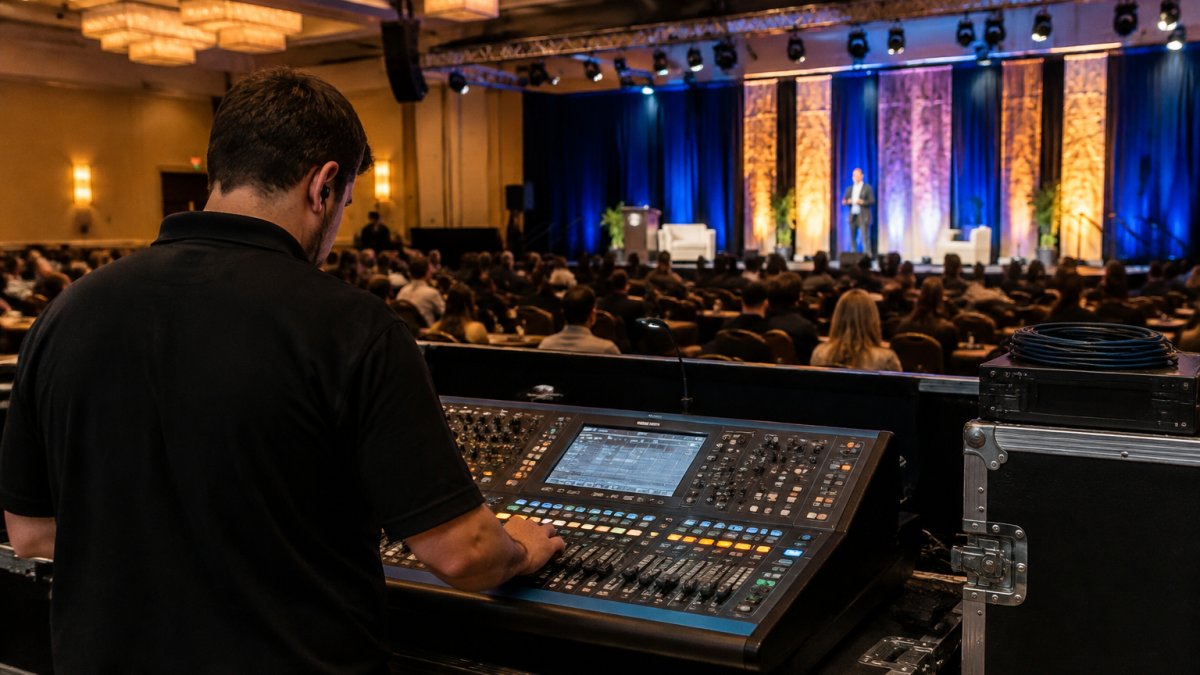
Video is where budgets quietly expand. Decide early whether you are projecting slides only, playing embedded video, or live streaming to a remote audience; each adds equipment and a person to run it.
Lighting does more work than most planners expect. If you are weighing options for a conference stage, our guide to the best stage lighting for corporate events breaks down the trade-offs.
Staging and scenic design come last because they follow the room. A modest riser with clean sightlines beats an elaborate set that blocks the screen.
Event Production Examples: Three Conference Setups and What They Required
Three conference formats account for most corporate production requests, and each one demands a different production posture rather than a bigger version of the same package.
A single-room leadership retreat. Small attendee count, high stakes. The requirement is flawless speech audio, a clean slide path and lighting that works for both a seated discussion and a standing presentation.
A multi-track conference with concurrent breakouts. This is a coordination problem more than a technical one.
A product launch with a hybrid audience. The room is a broadcast studio as much as a venue.
The pattern across all three: the technical package scales with complexity, not with headcount.
Risk, Hybrid Coverage and Measuring Whether the Conference Worked
Risk planning and outcome measurement are the two areas conference teams most often leave until the last minute, and both are cheaper to build in early. The practical version is a short written plan that names a backup for each critical system, a single decision-maker for schedule changes, and a measurement framework agreed before the event.
Start with a contingency table that maps each realistic failure to a response and an owner. A common pattern looks like this:
| Failure | Backup | Owner |
|---|---|---|
| Main projector fails mid-keynote | Spare projector or confidence-monitor feed to side screens | Video lead |
| Wireless mic drops out | Spare mic on the same frequency plan, charged and tested at rehearsal | Audio lead |
| Power loss on stage | Venue house power on a separate circuit; UPS for playback and show-calling | Production lead |
| Speaker no-show or late | Pre-recorded backup segment or extended Q&A with moderator | Show caller |
| Schedule slip past a hard stop | Pre-agreed cut list of non-critical segments | Decision-maker (single named role) |
| Stream drops for remote audience | Backup encoder and a second network path | Technical director |
The escalation path matters as much as the backups. Name one person authorized to change the schedule on show day, and make sure every vendor and venue contact knows who that is. Equipment failure is not rare; unpreparedness is optional.
Hybrid coverage deserves its own line in the plan rather than a footnote. As Cvent's event statistics analysis notes, planners in 2026 are under pressure to design more efficient events without dropping the quality of the attendee experience, and hybrid done badly is the fastest way to lose both audiences at once.
Measurement should be defined before the event, not after.
Watch out: teams often collect stream analytics but never compare them to the on-site attendance data, so they cannot tell whether the hybrid audience was additive or simply a substitute for people who would have attended anyway.
Booking a Production Walkthrough for Your Next Conference
The fastest way to find out whether your conference plan is technically sound is a walkthrough of the actual space with a production lead before contracts are finalized. Most problems that surface on show day are visible in an empty room months earlier.
Bring the right questions to that meeting. Our guide to what to ask event production companies covers the questions that separate a coordinated team from a rental desk. If you are ready to move, you can request a custom production quote with your event details and let the numbers drive the decision.
Your next conference does not need to be the one where the audio failed during the keynote. AudioBahn Productions manages scheduling, contracts and payments alongside concert sound, stage lighting, staging and backline, so one team owns the outcome from site walk to load-out.
Frequently Asked Questions
What does event production management include for a corporate conference?
It covers the technical and operational side of the show: audio, video, lighting, staging, power distribution, run of show, rehearsals, and on-site crew. A production manager coordinates vendors, confirms equipment against your room and attendee count, schedules load-in and load-out, and holds the cue calls during the general session. Planning and contract administration usually sit with the same team, so scheduling, payments, and supplier coordination stay in one place instead of being split across separate vendors.
What is the difference between event management and event production?
Event management handles the attendee-facing program: registration, invitations, catering, venue sourcing, and the overall budget. Event production handles what the audience sees and hears: stage setup, scenic design, AV equipment, technical production, and show execution. On a corporate conference the two overlap at the run of show, which is why one owner should hold the master schedule. Splitting them without a clear handoff is where cue times and vendor arrivals start to slip.
How far ahead should we lock in our event production timeline?
For a conference with a general session and breakout rooms, start production planning 12 to 16 weeks out. Venue selection and event objectives come first, then the production timeline and budget, then vendor coordination and equipment confirmation. Finalize the run of show and hold rehearsals in the last two weeks. Compressing that into four weeks is possible for a single-room meeting, but multi-room conferences need the full window to absorb venue load-in rules and speaker changes.
What should we ask an event production company before hiring them?
Ask for event production examples from conferences close to your attendee count and room type, and ask who is responsible if equipment fails mid-show. Confirm they will do a site walkthrough and check your room's power, rigging points, and load-in access before quoting. Ask how they document technical specifications so the gear that arrives matches your stage setup. Also ask whether they handle logistics beyond AV, such as tents or restroom trailers, so you are not rebuilding a vendor list later.
Can one production partner cover a smaller corporate event, not a full-scale conference?
Yes. A single-room meeting with one presenter still needs audio, a projector or LED wall, stage lighting, and a technician who knows the cue sequence. The scope shrinks, not the need for coordination. Smaller events are often where piecemeal rentals cause the most trouble, because no one owns the handoff between the sound vendor and the lighting vendor. A production partner scoped to your attendee count and room size keeps the equipment list matched to the actual technical requirements.
How do you measure whether conference production paid off?
Track session attendance against registration, how many attendees stayed through the closing session, and whether the stream held up for remote viewers. Capture speaker feedback on audio clarity and confidence on stage, since those affect how the content lands. Compare the production spend against your event objectives, whether that was a product launch, a leadership retreat, or a trade show presence. Numbers you can pull from registration and streaming data are more useful than a post-event survey alone.

Sound, lighting, staging and LED video. Free quote.
Frequently Asked Questions
What does event production management include for a corporate conference?
It covers the technical and operational side of the show: audio, video, lighting, staging, power distribution, run of show, rehearsals, and on-site crew. A production manager coordinates vendors, confirms equipment against your room and attendee count, schedules load-in and load-out, and holds the cue calls during the general session. Planning and contract administration usually sit with the same team, so scheduling, payments, and supplier coordination stay in one place instead of being split across separate vendors.
What is the difference between event management and event production?
Event management handles the attendee-facing program: registration, invitations, catering, venue sourcing, and the overall budget. Event production handles what the audience sees and hears: stage setup, scenic design, AV equipment, technical production, and show execution. On a corporate conference the two overlap at the run of show, which is why one owner should hold the master schedule. Splitting them without a clear handoff is where cue times and vendor arrivals start to slip.
How far ahead should we lock in our event production timeline?
For a conference with a general session and breakout rooms, start production planning 12 to 16 weeks out. Venue selection and event objectives come first, then the production timeline and budget, then vendor coordination and equipment confirmation. Finalize the run of show and hold rehearsals in the last two weeks. Compressing that into four weeks is possible for a single-room meeting, but multi-room conferences need the full window to absorb venue load-in rules and speaker changes.
What should we ask an event production company before hiring them?
Ask for event production examples from conferences close to your attendee count and room type, and ask who is responsible if equipment fails mid-show. Confirm they will do a site walkthrough and check your room's power, rigging points, and load-in access before quoting. Ask how they document technical specifications so the gear that arrives matches your stage setup. Also ask whether they handle logistics beyond AV, such as tents or restroom trailers, so you are not rebuilding a vendor list later.
Can one production partner cover a smaller corporate event, not a full-scale conference?
Yes. A single-room meeting with one presenter still needs audio, a projector or LED wall, stage lighting, and a technician who knows the cue sequence. The scope shrinks, not the need for coordination. Smaller events are often where piecemeal rentals cause the most trouble, because no one owns the handoff between the sound vendor and the lighting vendor. A production partner scoped to your attendee count and room size keeps the equipment list matched to the actual technical requirements.
How do you measure whether conference production paid off?
Track session attendance against registration, how many attendees stayed through the closing session, and whether the stream held up for remote viewers. Capture speaker feedback on audio clarity and confidence on stage, since those affect how the content lands. Compare the production spend against your event objectives, whether that was a product launch, a leadership retreat, or a trade show presence. Numbers you can pull from registration and streaming data are more useful than a post-event survey alone.