How to Vet Production Company Technical Expertise for Venues
Last Updated: November 14, 2026
Quick Summary
Production company technical expertise for venues is the practical ability to plan, run, and troubleshoot every technical system a live event depends on, from the first site survey to the final teardown. Verify it across five disciplines: audio, lighting, video, staging and rigging, and production planning. Test the claim with an in-person site survey and a scored venue checklist.
- Ask which of the five technical disciplines the company handles in-house and which it subcontracts.
- A venue AV system evaluation should happen in person, with the room empty, and produce documents you keep.
- A good walkthrough ends with a room diagram, equipment condition list, and written scope split.
- Demand a written logistics checklist that names who owns each line, with phone numbers.
- Confirm what spare cables, microphones, and fixtures come to the site before you sign.
Table of Contents
- What Production Company Technical Expertise for Venues Actually Covers
- Running a Site Survey and Venue AV System Evaluation
- Building a Technical Rider Template for Live Bands That Holds Up
- The Event Production Logistics Checklist Every Venue Should Demand
- Where the Venue's Responsibility Ends and the Production Company's Begins
- Redundancy, Contingency, and What Happens When Gear Fails Mid-Show
- Volunteer AV Team Training and Handoff After the Show
- Book a Free Walkthrough and Put the Checklist to Work
- Frequently Asked Questions
What Production Company Technical Expertise for Venues Actually Covers
Production company technical expertise for venues is the practical ability to plan, run, and troubleshoot every technical system a live event depends on, from the first site survey to the final teardown. It is a discipline you can check, not a vibe you have to trust.
Below, we break down the five disciplines to verify, the walkthrough questions that expose weak vendors, and a checklist you can take into any meeting.
The Five Technical Disciplines to Verify
A real production partner should cover all five of these, not just one:
- Audio system design and sound reinforcement: speaker placement, coverage, and feedback control.
- Lighting design and control: fixtures, console programming, and cue timing.
- Video, projection, and displays: screen sizing, sightlines, and signal flow.
- Staging and rigging: safe structures and load planning.
Ask which of these the company handles in-house and which it subcontracts.
Running a Site Survey and Venue AV System Evaluation
A venue AV system evaluation is a structured inspection of the room's power, acoustics, rigging points, and existing gear before any contract is signed. For a deeper walkthrough process, see our guide on 7 Steps to Verify Technical Event Specs Before Show Day.
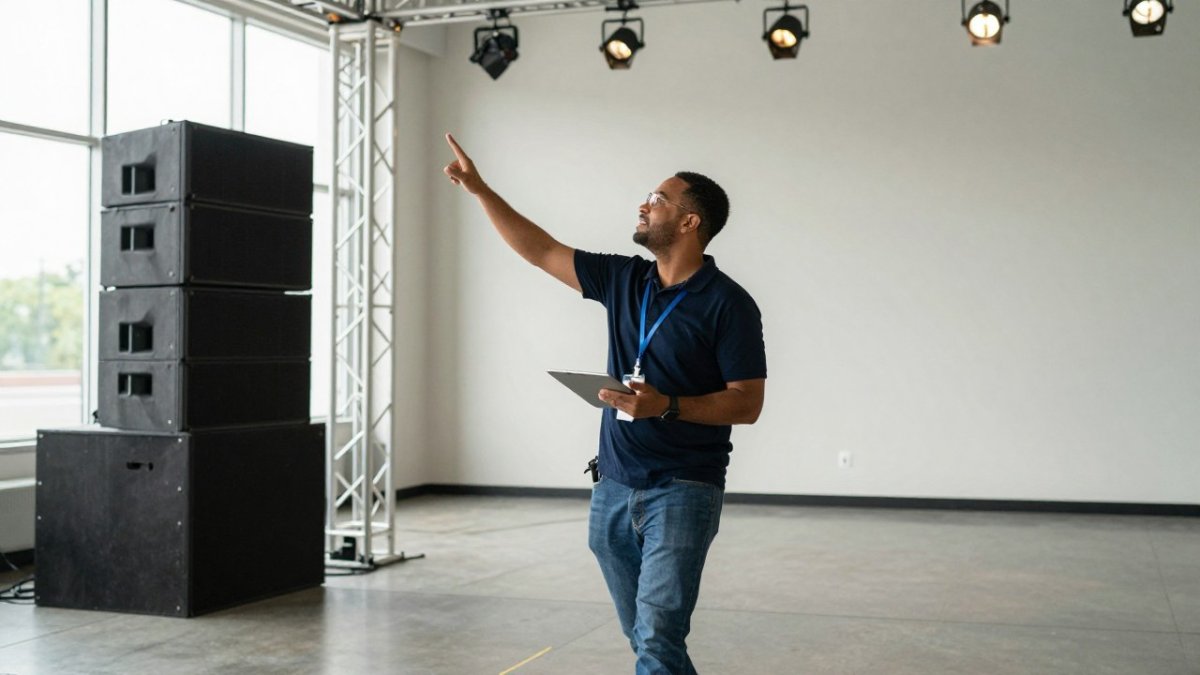
A Venue-Specific Technical Expertise Checklist
Most vendors claim venue experience. The way to test that claim is to make them demonstrate it against your building's actual constraints. Use this checklist during the walkthrough and score each line as confirmed, unclear, or missing. A partner who can only confirm a few lines is guessing.
Access and load-in
- Door widths, dock height, and freight elevator dimensions, measured rather than estimated
- The longest single cable run and the largest case that must pass through the tightest opening
- Load-in window versus the venue's other bookings, and whether the dock is shared
- Floor protection requirements and any weight limits on ramps or elevators
Power
- Available service amperage, outlet types, and which circuits are dedicated versus shared
- Distance from the nearest usable panel to the stage and the gauge of cable needed to cover it
- Whether the building has a generator hookup or transfer switch, and who is authorized to connect
- Known nuisance trips, coffee makers, kitchen equipment, or HVAC on the same leg
Rigging and structure
- Certified rigging points, their rated capacity, and who holds the certification
- Whether the ceiling is structural or a drop ceiling that cannot carry load
- Clear height under the lowest obstruction, not the room's advertised ceiling height
- Any prohibition on drilling, hanging, or attaching to finishes
Acoustics
- Room volume, surface materials, and the reverberation time a technician would expect
- Known dead spots, slap-back surfaces, and noisy HVAC or refrigeration nearby
- Whether the house system is tuned and to what reference
House systems
- Make, model, and age of the console, amplifiers, speakers, and projectors
- Whether the house system accepts an external feed and how it is patched
- Who holds the passwords and presets, and whether the venue will release them
- Documented failure history and any parts that are no longer serviceable
Network and signal
- Available bandwidth, wired drops, and whether guest Wi-Fi is segmented from production traffic
- Whether the venue permits the production company to run its own access point
- Cellular coverage in the room for backup connectivity
What a Thorough Walkthrough Should Produce
A good walkthrough ends with paperwork, not a handshake. You should walk away with:
- A room diagram marking power drops, rigging points, and speaker positions
- A list of existing equipment with its condition
- Notes on acoustics, dead spots, and sightline problems
- A written scope of what the company supplies versus what you supply
- A completed copy of the checklist above with every unclear line flagged for follow-up
If a vendor skips the survey and quotes from a photo, that is your first warning sign. Watch out: a vendor who walks the room but never asks to see the panel, the rigging certification, or the dock will still miss the constraints that cause show-day failures.
Questions That Expose Real Venue Familiarity
Beyond the checklist, ask scenario questions and listen for specific answers rather than general assurances:
- "The house console loses power mid-show. Walk me through your recovery."
- "Our HVAC cycles on during quiet moments. How would you address that in the design?"
- "The freight elevator is out. What is your alternate load-in?"
- "Show me a room with similar dimensions and materials you have worked in, and what you changed after the first show."
Building a Technical Rider Template for Live Bands That Holds Up
A technical rider template for live bands is a written document listing every input, output, power need, and stage requirement an act brings to your room. The rider protects the venue as much as the band. A vague rider is where shows go sideways.
Build yours around these sections:
- Input list: every microphone and instrument channel, in order.
- Stage plot: where each performer and piece of gear sits.
- Power needs: what draws current and where.
- Backline: what the band brings and what the venue provides.
- Lighting and video cues: any looks or playback the act requires.
For more on preventing show-day surprises, read how to avoid technical failures at live events.
The Event Production Logistics Checklist Every Venue Should Demand
An event production logistics checklist is the shared timeline that keeps load-in, rehearsal, show, and teardown from colliding. Demand one in writing, and demand that it names who owns each line.
| Phase | What to Confirm | Who Owns It |
|---|---|---|
| Load-in | Dock times, door access, crew count | Production company |
| Setup | Power, rigging, cable runs | Production company |
| Rehearsal | Sound check and cue-to-cue | Both parties |
| Show | Show calling and run of show | Production company |
| Teardown | Strike times, load-out, cleanup | Both parties |
A checklist without named owners is just a wish list. Insist on names and phone numbers.
Where the Venue's Responsibility Ends and the Production Company's Begins
Most disputes come down to one question: who was supposed to handle that? A simple responsibility matrix settles it before the event, not after. The matrix matters most for the items that fall between the two parties, permits, labor, network access, safety checks, and coordination with venue staff, because those are where scope gaps hide.
Building the Responsibility Matrix
Assign every line to one owner: the venue, the production company, or shared with a named lead. "Shared" without a lead is how tasks get dropped. Use a table like this as your starting point and edit it against your building's rules.
| Item | Typical Owner | What to Confirm in Writing |
|---|---|---|
| Building power capacity and panel access | Venue | Available amperage, outlet types, who connects |
| Rigging points and structural certification | Venue | Rated capacity, certification holder, inspection date |
| Loading access, dock times, freight elevator | Venue | Windows, dimensions, shared-use rules |
| Fire and safety compliance, occupancy limits | Venue | Sprinkler clearance, exit paths, open-flame rules |
| Event permits and noise ordinances | Shared | Who files, who pays fees, who holds the permit |
| Gear, crew, setup, and teardown | Production company | Crew count, call times, strike deadline |
| Show calling and run of show | Production company | Cue sheet owner, communication plan |
| Network access and bandwidth | Shared | Wired drops, segmentation, who configures |
| Safety checks and incident response | Shared | Site safety lead, escalation contacts |
| Coordination with venue staff | Shared | Single point of contact on each side |
The Items That Cause the Most Disputes
Permits. Confirm who files for the event permit, who pays any associated fee, and whose name appears on the application.
Network access. Production traffic, control systems, streaming, point-of-sale, should not share an unsegmented guest network.
Safety checks. Name a site safety lead and a backup, and confirm who conducts the pre-show walkthrough.
Coordination with venue staff. Name one point of contact on each side.
Write the split into the contract.
Redundancy, Contingency, and What Happens When Gear Fails Mid-Show
Gear fails. The question is whether your partner planned for it.
Ask these questions before you sign:
- What spare cables, microphones, and fixtures come to the site?
- Is there a backup console or signal path for the main audio?
- Who is on site during the show, and how fast can they swap a failed unit?
- What is the escalation plan if a problem outlasts the show?
Volunteer AV Team Training and Handoff After the Show
Volunteer AV team training is the difference between a system your people can run and one that only the vendor understands.
For faith-based rooms, our church sound and AV installation service is built around volunteers, with a free site visit and systems designed for people who are not full-time technicians.
After the show, the handoff should include:
- A short walkthrough of what changed in the system
- Written notes on settings, presets, and common fixes
- A simple troubleshooting sheet posted at the console
Book a Free Walkthrough and Put the Checklist to Work
The fastest way to test a production company's technical expertise is to watch how they walk your room. Bring this checklist to the meeting and see what they catch that you missed.
AudioBahn Productions offers a free walkthrough and evaluation of your system, and we recommend upgrades only where they are needed. Ready to see what your venue is missing? Review our event production services to confirm we cover your needs, or request a free quote and tell us about your next event.
Your room has technical gaps you cannot see from the audience, and they only show up when the house is full. Let AudioBahn Productions walk your venue, document what we find, and recommend only the upgrades that matter.
Frequently Asked Questions
What technical services should a venue production company provide?
A production company's technical expertise for venues should cover audio system design and sound reinforcement, lighting design and control, video and projection, staging and rigging, and live streaming for hybrid events. Beyond gear, look for technical direction, show calling, run of show management, setup and teardown, and on-site troubleshooting. Ask for a written scope that names who handles power requirements, network connectivity, and Wi-Fi, because those are the items most often dropped between vendors.
How can a production company assess a venue's sound and lighting systems?
The assessment starts with a site survey: room dimensions, ceiling height and rigging points, existing acoustics, power availability, and the condition of installed AV systems. A venue AV system evaluation should also test the equipment you already own before recommending anything new, so upgrades are limited to what the room actually needs. Ask for the findings in writing, including a responsibility matrix showing which systems the venue maintains and which the production company brings in.
Can a production company train a venue's volunteer AV team?
Yes, and it is worth asking for. Volunteer AV team training typically covers basic mixing and gain structure, lighting console operation, safe cable handling, and a written show-day checklist the volunteers can follow without a technician present. Ask whether training happens on your installed equipment rather than a demo rig, and whether you get documentation afterward. A production company that trains your crew leaves you less dependent on outside support for smaller events.
What should a venue include in a technical rider for touring bands?
A technical rider template for live bands should list stage dimensions and load-in access, available power and outlets, house audio and lighting inventory with model numbers, rigging capacity, dressing rooms, curfew times, and the name of the on-site technical contact. Include a section for what the venue does not provide so the band's production manager can plan around it. Send the rider before the advance call, and update it whenever equipment changes.

Sound, lighting, staging and LED video. Free quote.
Frequently Asked Questions
What technical services should a venue production company provide?
A production company's technical expertise for venues should cover audio system design and sound reinforcement, lighting design and control, video and projection, staging and rigging, and live streaming for hybrid events. Beyond gear, look for technical direction, show calling, run of show management, setup and teardown, and on-site troubleshooting. Ask for a written scope that names who handles power requirements, network connectivity, and Wi-Fi, because those are the items most often dropped between vendors.
How can a production company assess a venue's sound and lighting systems?
The assessment starts with a site survey: room dimensions, ceiling height and rigging points, existing acoustics, power availability, and the condition of installed AV systems. A venue AV system evaluation should also test the equipment you already own before recommending anything new, so upgrades are limited to what the room actually needs. Ask for the findings in writing, including a responsibility matrix showing which systems the venue maintains and which the production company brings in.
Can a production company train a venue's volunteer AV team?
Yes, and it is worth asking for. Volunteer AV team training typically covers basic mixing and gain structure, lighting console operation, safe cable handling, and a written show-day checklist the volunteers can follow without a technician present. Ask whether training happens on your installed equipment rather than a demo rig, and whether you get documentation afterward. A production company that trains your crew leaves you less dependent on outside support for smaller events.
What should a venue include in a technical rider for touring bands?
A technical rider template for live bands should list stage dimensions and load-in access, available power and outlets, house audio and lighting inventory with model numbers, rigging capacity, dressing rooms, curfew times, and the name of the on-site technical contact. Include a section for what the venue does not provide so the band's production manager can plan around it. Send the rider before the advance call, and update it whenever equipment changes.