7 Reasons Professional Staging Matters for Events
Last Updated: November 24, 2026
Quick Summary
Professional staging matters for events because it determines whether the audience can see the presenter, whether the production looks credible, and whether the setup holds up safely through a full program. Sightlines, lighting angles, sound coverage, and brand presentation all hang off the stage, so getting the platform wrong makes every other production decision fight the room.
- Confirm venue ceiling height, rigging points, power, load-in path, and floor load limits six to eight weeks out.
- Match stage height and layout to the room rather than a rental catalog to protect back-row sightlines.
- Build the stage around the format, whether keynote, panel, award show, product launch, training, or hybrid.
- Plan deck, access, power, and rigging as one system so setup runs faster and looks intentional.
- Include accessible ramps or lifts, caption visibility, and cable ramps so every guest can follow the program.
Table of Contents
- Why does professional staging matter for events?
- How Professional Staging Elevates Event Logistics
- Sightlines, Stage Height, and Audience Visibility
- Corporate Event Stage Setup That Fits Your Format
- Event Staging Equipment: What a Real Production Kit Includes
- Stage Lighting for Corporate Events: More Than Decoration
- Event Stage Safety and the Costs of DIY Setups
- Book a Free Walkthrough Before Your Next Event
- Frequently Asked Questions
Why does professional staging matter for events?
Professional staging matters for events because it determines whether the audience can see the presenter, whether the production looks credible, and whether the setup holds up safely through a full program. A stage is the physical anchor of the room: sightlines, lighting angles, sound coverage, and brand presentation all hang off it. Get the platform wrong and every other production decision fights the room.
Planners often spend heavily on content and talent, then hand the platform to whoever answers the phone first. That order is backwards. The stage is what your attendees photograph, what your speaker stands on, and what your brand sits inside for the entire event.
Below, we break down what professional staging actually changes, from logistics to safety, and where DIY setups quietly cost more than they save. Readers who want to see what staging options the company actually offers can jump straight to the stage rental service page.
How Professional Staging Elevates Event Logistics
Logistics is where staging earns its keep before the doors open. A temporary stage with a documented layout means load-in, setup, and teardown follow a sequence instead of a scramble. Crews know where the deck goes, where cable runs, and when lighting truss flies.
The difference shows up in three places:
- Scheduling. One production partner coordinates staging, sound, and lighting on a single timeline, so no vendor waits on another.
- Setup and teardown. Modular stage platforms assemble in a predictable order, which shortens the window between a morning session and an evening gala in the same ballroom.
- Coordination. Contract administration, payment schedules, and crew calls sit with one team instead of four.
Many planners find that vendor coordination is the real time sink, not the equipment itself. When staging, audio, and lighting come from separate suppliers, every handoff becomes a meeting.
Sightlines, Stage Height, and Audience Visibility
Sightlines decide whether the back row experiences your event or watches the back of someone's head. Stage height, stage layout, and screen placement work together: raise the deck too little and the audience strains, raise it too much and the front rows crane upward.
In practice, this means matching the stage platform to the room, not to a rental catalog. A banquet hall with a low ceiling and a wide floor plan needs a different layout than a theater with raked seating. Presenter movement matters too. A speaker who walks the stage needs clear deck space and cable management that does not turn into a trip hazard.
What most guides miss is that visibility problems rarely announce themselves during planning. They appear on event day, when the first speaker steps out and half the room shifts in their chairs.
Corporate Event Stage Setup That Fits Your Format
Corporate event stage setup should follow the format, not the other way around. A product launch, a conference keynote, an award show, and a training session each need different stage dimensions, backdrop options, and presenter positions. The format dictates the build.
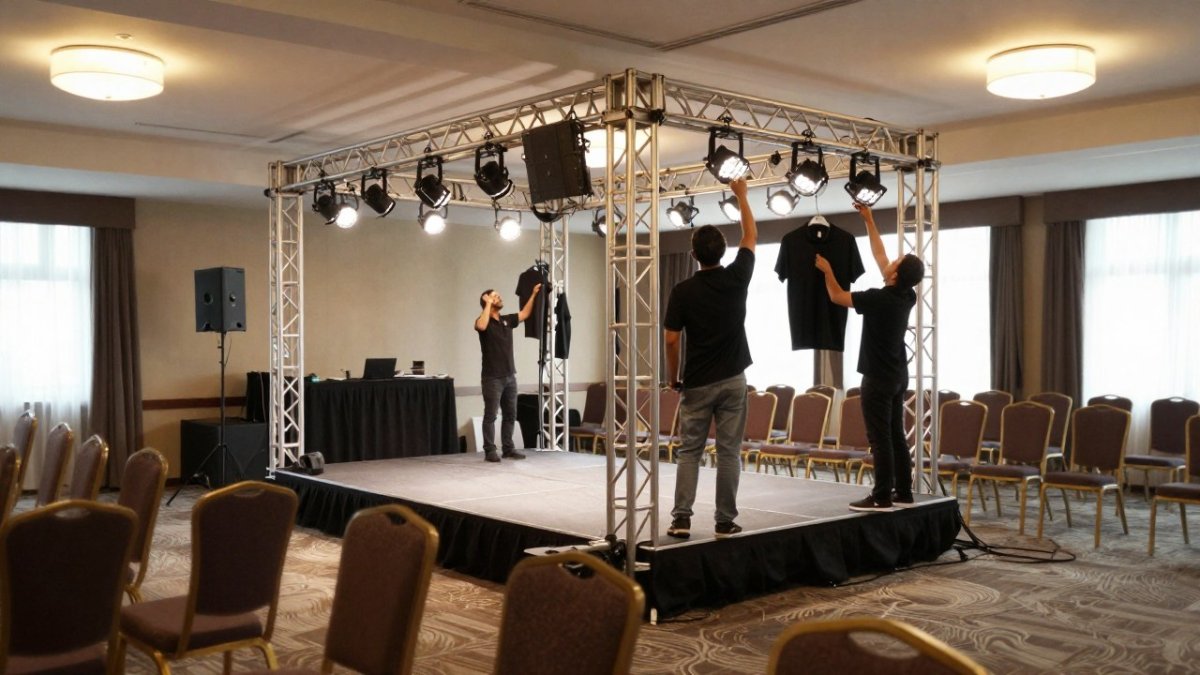
For planners who want staging paired with sound and video, our corporate AV production covers the full build. A few format considerations we walk clients through:
- Keynotes: wide, shallow deck with a clean backdrop and confident sightlines to the screen.
- Panels: longer stage with room for seating and microphones that do not clutter the sightline.
- Award shows: deeper stage for entrances and exits, plus lighting positions that flatter the moment.
- Product launches: a reveal zone with controlled sightlines, a clean backdrop for cameras, and cable management hidden from the front row.
- Training sessions: a lower deck with easy presenter movement, whiteboard or screen access, and seating arranged so every table can see.
- Hybrid events: camera-safe lighting, a backdrop that reads on video, and presenter marks so remote viewers see a composed frame.
- Outdoor venues: wind-rated backdrops, weighted ballast, covered power, and a weather contingency that does not require rebuilding the deck mid-program.
The throughline is simple: build the stage around what happens on it.
A Practical Planning Timeline
Most staging problems are scheduling problems in disguise. A workable sequence looks like this:
- Venue review (six to eight weeks out). Confirm ceiling height, rigging points, power, load-in path, and floor load limits before design starts.
- Design approval (four to six weeks out). Lock stage dimensions, backdrop, lighting positions, and screen placement against the program run-of-show.
- Load-in plan (two weeks out). Assign crew calls, dock times, and the order of staging, audio, and lighting so no vendor waits on another.
- Rehearsal (day before or morning of). Walk presenter marks, test sightlines from the back row, and check camera framing if the event is streamed.
- Show operation. Keep one production lead on headset who can adjust lighting, audio, and stage changes on cue.
- Teardown. Sequence the strike so rented equipment is counted and returned on schedule.
Watch out: the most common timeline failure is approving a stage design before the venue's rigging and power are confirmed, which forces a redesign after deposits are already committed.
Accessibility and Inclusive Stage Design
Accessibility is where format planning often falls short. A stage that works for a standing keynote can fail a presenter who uses a wheelchair or a guest who needs to reach the deck without stairs. Practical steps include:
- Accessible stage access: ramps with compliant slope and handrails, or a lift where the deck height requires it.
- Sightlines for seated guests: check the view from wheelchair spaces and the back row, not just the center aisle.
- Caption visibility: place captioning screens where the audience can see them without turning away from the presenter.
- Presenter movement: clear deck space, cable ramps, and lighting that does not blind a presenter entering from the side.
These details rarely appear in staging guides, but they decide whether every guest experiences the program or watches around an obstacle.
Event Staging Equipment: What a Real Production Kit Includes
Event staging equipment is more than a deck and a skirt. A working production kit includes modular stage platforms, adjustable legs, guardrails where the layout calls for them, skirting, stairs, cable ramps, and the truss and rigging that carry lighting and audio.
A common mistake is renting the platform and forgetting everything that makes it usable. Stairs get added late. Cable ramps get skipped. Then the presenter walks on with a handheld mic and a loose run of cable across the deck.
We treat staging as one system: deck, access, power, and rigging planned together. When the kit is complete, setup runs faster and the stage looks intentional from every seat.
Stage Lighting for Corporate Events: More Than Decoration
Stage lighting for corporate events shapes what the audience looks at and how the presenter reads on camera. Lighting defines the stage edge, separates the speaker from the backdrop, and keeps the room's attention where the program needs it. It is a functional layer, not a decoration budget.
Illuminating Engineering Society lighting standards guidance treats stage and presentation lighting as a visibility problem first. In practice, that means front light on the presenter, controlled spill into the audience, and fixtures positioned so the speaker is never lit from directly below.
Readers who want to see fixture options and book a setup can review our event lighting rental offering. The right lighting package makes a modest stage look polished and a large one look controlled.
Event Stage Safety and the Costs of DIY Setups
Event stage safety comes down to load capacity, stability, and installation done by people who build stages routinely. A platform rated for a speaker and a podium is not the same as one that holds a full band, and the difference is not visible from the audience.
Three mechanisms drive most safety outcomes:
- Load distribution. Deck panels, legs, and bracing spread weight across the floor. A stage sized for a single presenter can be overloaded by a drum kit, a choir riser, or a dense panel table.
- Stability and anchoring. Guardrails, stairs, and anchoring keep the deck from shifting when a presenter walks the edge or the audience surges forward.
- Installation quality. Cable ramps, secured skirting, and lighting placed with heat and access in mind prevent the trip-and-fall and heat hazards that show up after doors open.
DIY setups carry hidden costs that rarely show up on the rental invoice:
- Time: staff hours spent assembling, troubleshooting, and tearing down, often on overtime.
- Risk: unstable decking, unsecured cable, and lighting placed without regard for heat and access.
- Rework: equipment that does not match the venue's power or rigging situation.
- Contingency gaps: no backup plan for a failed fixture, a weather shift outdoors, or a power drop mid-program.
Watch out: the most common failure we see is a stage built for the room's footprint but not its load, which turns a routine program into a safety question. Seeing real staged productions in the event production gallery helps readers trust professional setups over DIY.
Contingency Planning and Sustainability
A professional build includes a plan for what goes wrong. Practical contingencies include backup lighting fixtures, a spare wireless microphone channel, covered power for outdoor stages, and a weather threshold that triggers a covered or indoor fallback. Sustainability matters too: reusable modular decking, LED fixtures that draw less power, and a teardown plan that separates materials for reuse reduce waste without raising production risk.
Measuring Whether Staging Paid Off
Our event production gallery shows staged builds across a range of venues if you want a sense of what a finished setup looks like.
Book a Free Walkthrough Before Your Next Event
A free walkthrough removes the guesswork from staging decisions. We evaluate your system and recommend only the upgrades your event actually needs, and we offer training for volunteer tech crews.
That is the practical answer to why professional staging matters for events: fewer surprises on event day, a stage that fits the format, and one team accountable for the build. We also support church production and are expanding into broader live event logistics, including tents and related live-event support.
Staging decisions get made once, but the room remembers them all day. If you are planning a corporate event, gala, or conference and want a stage that fits the venue and the format, get started with AudioBahn Productions and book a free walkthrough of your system.
Frequently Asked Questions
What is professional event staging?
Professional event staging covers the design, build, and operation of a temporary stage and everything attached to it: the stage platform, stairs, railings, backdrop, lighting, sound, and AV setup.
How does professional staging improve event safety?
Event stage safety depends on load capacity, stability, and correct installation, and those are hard to judge from a rental catalog.
What should a corporate event stage setup include?
A workable corporate event stage setup usually includes a stage platform sized to the room, a backdrop, stage lighting, a sound system matched to the space, and AV for slides or video. AudioBahn Pro offers a free walkthrough and evaluation of your system.
When should you hire a professional staging company?
Hire one as soon as the event date and venue are locked, especially if the program includes lighting cues, video, or multiple presenters. Professional staging equipment and crew schedules fill up, and early planning gives time for a site walkthrough, a stage layout that fits the room, and training for any volunteer tech crew. Smaller corporate events still benefit; the scope scales down, the coordination does not.

Sound, lighting, staging and LED video. Free quote.
Frequently Asked Questions
What is professional event staging?
Professional event staging covers the design, build, and operation of a temporary stage and everything attached to it: the stage platform, stairs, railings, backdrop, lighting, sound, and AV setup.
How does professional staging improve event safety?
Event stage safety depends on load capacity, stability, and correct installation, and those are hard to judge from a rental catalog.
What should a corporate event stage setup include?
A workable corporate event stage setup usually includes a stage platform sized to the room, a backdrop, stage lighting, a sound system matched to the space, and AV for slides or video. AudioBahn Pro offers a free walkthrough and evaluation of your system.
When should you hire a professional staging company?
Hire one as soon as the event date and venue are locked, especially if the program includes lighting cues, video, or multiple presenters. Professional staging equipment and crew schedules fill up, and early planning gives time for a site walkthrough, a stage layout that fits the room, and training for any volunteer tech crew. Smaller corporate events still benefit; the scope scales down, the coordination does not.