How to Hire an Event Production Team for Weddings
Last Updated: November 22, 2026
Quick Summary
Hire an event production team for weddings by putting audio, lighting, staging, and event-day execution under one contract and one point of contact. Ask about scope, staffing, insurance, and contingency before price, then lock your date with a signed scope and deposit.
- A production team owns equipment, technical labor, setup, and live operation of sound, lighting, staging, and video.
- Build your production timeline backward from the ceremony start time, with a named owner for each phase.
- Crew size scales with guest count and technical elements, not venue size alone.
- A verbal we have you down is not a booking without a signed scope and deposit.
- Confirm the on-site technical lead by name and get a direct phone number for event day.
Table of Contents
- What a Wedding Event Production Team Actually Handles
- Questions to Ask an Event Production Company Before You Book
- Building a Wedding Production Timeline That Holds Up
- The Wedding Production Checklist: Scope, Staffing, and Equipment
- What an Event Production Contract Should Spell Out
- Full-Service Versus Specialized: Matching the Team to Your Wedding
- Registering Your Wedding with a Production Partner
- Frequently Asked Questions
What a Wedding Event Production Team Actually Handles
The average couple now hires roughly 13 wedding professionals, according to The Knot's Real Weddings data reported by AllWedding.us, which explains why so many couples end up managing a small army of vendors on the biggest day of their lives.
An event production team is the group responsible for the technical and logistical build of a wedding: sound reinforcement, stage and dance floor lighting, staging, video, power, and the crew that runs all of it during the event. That is different from planning the wedding.
Planner, Coordinator, or Production Team: Who Does What
Three roles get blurred together, and the confusion costs couples money. Here is the clean split:
- Wedding planner: owns the vision, budget, and vendor selection, often starting a year or more out.
- Wedding coordinator: owns the schedule and vendor communication in the final weeks and on the day itself.
- Production team: owns equipment, technical labor, setup, and live operation of sound, lighting, staging, and video.
One team can wear two hats, but get the split in writing. If your coordinator assumes the DJ is handling ceremony audio and the DJ assumes the venue is, you have found the gap that ruins first dances.
Questions to Ask an Event Production Company Before You Book
Ask about scope, staffing, and contingency before you ask about price. A hiring guide from Full-Service Event Production: What It Covers and How to Hire recommends settling exactly what is included, who will be on site, what the venue permits, and who handles changes during the event before you sign anything.
Bring this list to every call:
- What is included in the quoted scope, and what triggers an extra charge?
- Who is the on-site technical lead, and will that person be at our wedding?
- How many crew members will be on site, and when do they arrive?
That last item matters more than most couples realize. When you are ready to talk through your own event, you can request a quote and get answers specific to your venue and guest count.
Building a Wedding Production Timeline That Holds Up
A wedding production timeline maps every technical task, from the first site walkthrough to the final cable coil, against your wedding date.
A workable sequence looks like this:
| Phase | Timing | What Happens |
|---|---|---|
| Site walkthrough | 3-6 months out | Measure the room, check power, confirm load-in access |
| Scope and contract | 2-4 months out | Lock equipment list, crew size, and insurance |
| Final details call | 2-3 weeks out | Confirm timeline, song cues, and speech order |
| Load-in and setup | Day before or morning of | Staging, rigging, sound and lighting install |
| Sound check | 2-3 hours before guests | Test every mic, playback source, and lighting cue |
| Live operation | Event day | Crew runs cues and monitors equipment |
| Load-out | After the last dance | Strike, pack, and clear the venue |
Watch out: the most common mistake is treating setup as a one-hour job. A reception with staging, dance floor lighting, and wireless mics for toasts needs real install time, and venues often cap how early you can load in.
The Wedding Production Checklist: Scope, Staffing, and Equipment
Scope, staffing, and equipment determine whether your production quote is realistic. A package that lists "sound and lighting" without specifying channel counts, fixture types, or crew size is not a quote, it is a guess.
Your checklist should cover:
- Audio: ceremony mics, lavaliers for officiant and readers, wireless handhelds for toasts, playback for processional and first dance, and a PA sized to the room and guest count.
- Lighting: ambient wash for dinner, dance floor fixtures, pin spots for centerpieces, and uplighting if the venue allows it.
- Staging: dance floor, band or DJ riser, and any ceremony platform the venue does not supply.
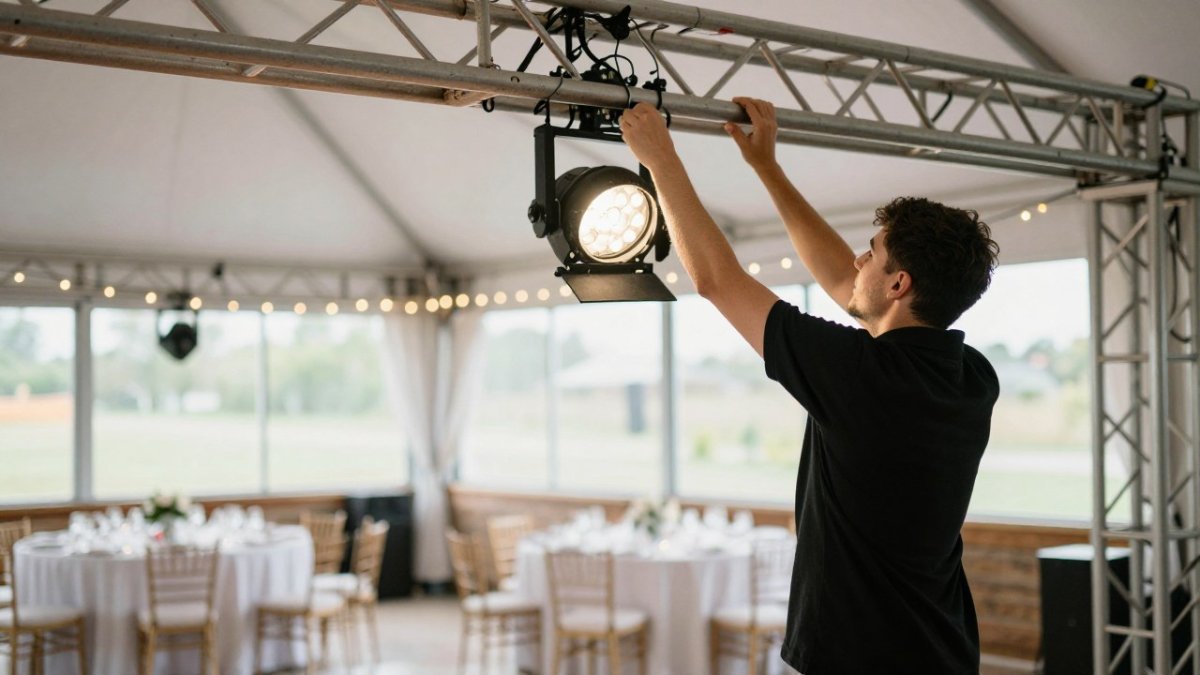
If you are still scoping sound, browse PA system rentals with delivery, setup, and engineers included, and review live event production scheduling and management for the logistics side. The event production services overview covers concert sound, lighting, staging, and LED video.
What an Event Production Contract Should Spell Out
An event production contract should name the equipment, the crew, the timeline, the payment schedule, and the cancellation terms in plain language. If a term is vague, it will be tested on the day you can least afford ambiguity.
The clauses worth scrutinizing:
- Scope of work: itemized equipment list, crew count, and hours on site.
- Payment schedule: deposit amount, due dates, and what happens to the deposit on cancellation.
- Change orders: how last-minute additions are priced and approved.
Ask for case studies or recent examples that demonstrate experience with similar challenges, timelines, or objectives, as The Panacea Co.'s hiring guidance recommends. A portfolio of comparable weddings tells you more than a glossy brochure.
Full-Service Versus Specialized: Matching the Team to Your Wedding
Full-service production suits weddings with multiple technical elements and tight coordination needs; specialized vendors suit small events with a single clear requirement.
Specialized pros: you can hire the best fit for each element and often spend less on simple events. Specialized cons: you become the coordinator, and every handoff between vendors is a place where details drop.
Here is the honest test. You can view the production gallery to judge the style and scale of past work before you decide.
Staffing Plans by Guest Count and Complexity
A common pattern is that crew size scales with guest count and the number of technical elements, not with the size of the venue alone. Use these ranges as a starting point when you compare quotes:
| Wedding profile | Typical crew | Roles on site |
|---|---|---|
| 50-75 guests, ceremony only, house sound | 1-2 | Audio engineer, setup hand |
| 75-125 guests, ceremony and reception, DJ and wireless mics | 2-3 | Audio engineer, lighting tech, setup/strike hand |
| 125-200 guests, live band, uplighting, staging | 3-5 | Audio engineer, lighting tech, stagehand, crew lead, setup/strike hands |
| 200+ guests or multi-room, video and livestream | 5-8+ | Crew lead, audio engineer, lighting tech, video tech, stagehands, power/distro tech |
Watch out: a quote that lists one technician for a 200-guest wedding with a live band and uplighting is understaffed, and the gap usually shows up as a delayed sound check or a lighting cue that never gets run.
How to Compare a Full-Service Quote to Specialized Bids
Put every bid on the same worksheet so you are comparing scope, not headlines. List each element, ceremony audio, reception audio, dance floor lighting, uplighting, staging, video, power, and mark whether it is included, excluded, or an add-on. Then add crew count, hours on site, and whether the on-site lead is named.
If your venue has unusual power, load-in, or rigging constraints, ask each bidder to describe how they handled a similar room.
Registering Your Wedding with a Production Partner
Registering your wedding with a production partner means formally booking your date and locking your scope, crew, and equipment into their schedule.
Registration is also where the paperwork gets real. Expect to provide your venue contact, load-in window, insurance requirements, and final equipment list. Confirm the on-site technical lead by name and get a direct phone number for event day.
The Booking Sequence, Step by Step
Most production partners follow a predictable sequence. Knowing it in advance keeps you from losing a date to a couple who moved faster.
- Hold the date. Ask for a short courtesy hold, often 7 to 14 days, while you confirm the venue and review the quote. A hold is not a booking, and it expires.
- Approve the scope in writing. Sign off on the itemized equipment list, crew count, and hours on site. This becomes the baseline for any change order.
- Pay the deposit. A deposit reserves the date and crew. Ask what portion is refundable and under what cancellation terms before you pay.
- Submit venue paperwork. Provide the venue's vendor rules, load-in window, and certificate of insurance requirements so the production company can comply before the event.
- Confirm the on-site lead. Get the name, cell number, and backup contact for the person running your event.
- Schedule the final details call. This usually happens 2 to 3 weeks out and locks the timeline, song cues, and speech order.
Watch out: a verbal 'we have you down' is not a booking. Without a signed scope and a deposit, the date may be released to another couple.
What to Get in Writing Before You Pay
A registration packet should include more than a confirmation email. Ask for these documents and read them before the deposit clears:
- Signed scope of work with the itemized equipment list, crew count, and on-site hours.
- Payment schedule showing the deposit, any progress payment, and the final balance due date.
- Cancellation and postponement terms, including what happens to the deposit if the date moves.
- Certificate of insurance naming your venue as additional insured if the venue requires it.
Insurance and Venue Compliance
Venues often require vendors on site to carry liability coverage. Ask the production company to send the certificate directly to your venue contact and confirm the coverage limits meet the venue's contract. Submit any vendor approval form early, approval can take days, and a missing certificate is one of the most common reasons a vendor is turned away at load-in.
Event-Day Contact and Escalation Plan
Agree on how you will reach the production team on event day and who has authority to approve changes.
The hardest part of hiring an event production team for weddings is not finding vendors. It is getting sound, lighting, staging, and crew to work as one system on a day that only happens once. AudioBahn Productions handles that coordination end to end, from scheduling and contract administration to concert-grade sound, stage lighting, and staging across Michiana and the Great Lakes region.
Frequently Asked Questions
When should I hire a wedding production team?
Start the search six to nine months before the wedding, and sign a contract no later than 90 days out. Weddings often involve many hired vendors, so production is one slot in a crowded schedule. Early booking matters most for peak-season Saturdays and for venues that restrict load-in windows. If your wedding falls in a busy month, add a month of buffer so the production team can review the venue's rules and confirm equipment before final counts are due.
What does a wedding event production team do that a DJ does not?
A DJ supplies music. An event production team supplies the sound system, microphones, stage lighting, staging, and the crew that runs them, plus event-day support for cues and power. That distinction decides who handles a ceremony mic failure or a lighting cue during toasts. Ask any candidate to list what is included, who is on site, and what the venue permits, because a booking alone does not prove the scope fits your wedding.
How do I choose an event production company for a wedding?
Compare three things: a written scope, recent examples from similar weddings, and a named on-site lead. Ask for case studies that show experience with your venue type or guest count, then check the event production contract for load-in times, overtime terms, and who handles changes during the event. Settling what is included and who will be on site before booking is advisable. Pricing depends on guest count, venue, and equipment, so get an itemized quote rather than a single lump sum.
What should a wedding production contract include?
Look for the equipment list by item, crew size and arrival times, load-in and load-out windows, overtime and change-order terms, payment schedule, and liability coverage. Confirm who is responsible if equipment fails mid-event and how fast a response is promised. The contract should also name the on-site lead and state how coordination with your planner and venue works. Review every line before signing, because gaps in scope are the most common source of event-day disputes.

Sound, lighting, staging and LED video. Free quote.
Frequently Asked Questions
When should I hire a wedding production team?
Start the search six to nine months before the wedding, and sign a contract no later than 90 days out. Weddings often involve many hired vendors, so production is one slot in a crowded schedule. Early booking matters most for peak-season Saturdays and for venues that restrict load-in windows. If your wedding falls in a busy month, add a month of buffer so the production team can review the venue's rules and confirm equipment before final counts are due.
What does a wedding event production team do that a DJ does not?
A DJ supplies music. An event production team supplies the sound system, microphones, stage lighting, staging, and the crew that runs them, plus event-day support for cues and power. That distinction decides who handles a ceremony mic failure or a lighting cue during toasts. Ask any candidate to list what is included, who is on site, and what the venue permits, because a booking alone does not prove the scope fits your wedding.
How do I choose an event production company for a wedding?
Compare three things: a written scope, recent examples from similar weddings, and a named on-site lead. Ask for case studies that show experience with your venue type or guest count, then check the event production contract for load-in times, overtime terms, and who handles changes during the event. Settling what is included and who will be on site before booking is advisable. Pricing depends on guest count, venue, and equipment, so get an itemized quote rather than a single lump sum.
What should a wedding production contract include?
Look for the equipment list by item, crew size and arrival times, load-in and load-out windows, overtime and change-order terms, payment schedule, and liability coverage. Confirm who is responsible if equipment fails mid-event and how fast a response is promised. The contract should also name the on-site lead and state how coordination with your planner and venue works. Review every line before signing, because gaps in scope are the most common source of event-day disputes.