Event Production Services for Chicago Venues: 2026 Guide
Table of Contents
- What Chicago Venues Actually Need From an Event Production Partner
- Comparing Event Production Services: What Providers Offer
- Building Your Event Production Checklist Before You Book
- Event Lighting and Staging: The Details That Make or Break a Show
- Mapping Your Event Production Timeline From Load-In to Load-Out
- What Belongs in an Event Production Proposal Template
- How to Choose the Right Provider for Your Venue and Event Type
- Conclusion: Getting Production Right the First Time
- Frequently Asked Questions
Last Updated: October 12, 2026
What Chicago Venues Actually Need From an Event Production Partner
Event production services for Chicago venues cover far more than dropping off speakers and a lighting rig. A production partner handles scheduling, crew calls, equipment spec, load-in logistics, and the contract paperwork that keeps a show legal and on budget. This guide from AudioBahn Productions breaks down what venues actually need, how providers differ, and how to choose well the first time.
Most venue managers we talk to have lived through the same nightmare: three vendors, two no-shows, and one lighting console that didn't match the plot. The fix isn't more vendors. It's fewer, better-coordinated ones.
Beyond Gear Rental: Coordination, Contracts, and On-Site Crews
Gear is the easy part. Anyone with a truck can rent you a PA system.
The hard part is everything around the gear: confirming the schedule weeks out, locking in the crew call, verifying the equipment list against your venue's power and rigging capacity, and having someone on site who owns the outcome when a channel goes dead mid-set.
That last point matters most. When you rent equipment piece by piece, responsibility is fragmented. When something fails, you're the one making calls at 7:45 p.m. while 800 people wait.
A production partner consolidates that risk. One contract, one point of contact, one crew that knows your room.
Comparing Event Production Services: What Providers Offer
Providers generally fall into two categories: specialists who focus on one discipline, and full-service shops that coordinate everything. Knowing which you need depends on your event type and how much you want to manage yourself.
Audio Visual, Staging, and Lighting Specialists
Specialists do one thing well. A sound-focused provider brings concert-grade audio, backline support, and engineers who mix live. A lighting-focused provider brings truss, fixtures, and programming.
The trade-off is coordination. If you hire three specialists, you become the production manager by default. That works for simple events. It falls apart the moment the schedule shifts.
Full-Service Logistics and Portable Entertainment Add-Ons
Full-service providers handle audio, staging, lighting, and the logistics around them. That now extends further than it used to. Venues and corporate planners increasingly want one partner for tents, restroom trailers, and other live-event support, plus entertainment options like portable laser tag for corporate outings, school events, and parties.
| Service Type | Best For | What You Still Manage |
|---|---|---|
| Single-discipline specialist | Simple events, tight budgets | Vendor coordination, scheduling |
| Multi-discipline provider | Mid-size concerts, conferences | Event-day decisions only |
| Full-service production partner | Large or complex events | Nothing on the production side |
Building Your Event Production Checklist Before You Book
A solid event production checklist prevents the two most expensive problems: equipment that doesn't match your venue and crew that arrives unprepared. Build the checklist before you request quotes, not after.
Start with these items:
- Venue power capacity and available circuits
- Rigging points, weight limits, and height clearance
- Load-in door dimensions and dock access times
- Curfew, noise ordinance, and union crew rules
- Insurance and certificate of insurance requirements
- Equipment list matched to your technical rider
- On-site contact for both parties
- Contingency plan for equipment failure
Event Lighting and Staging: The Details That Make or Break a Show
Lighting and staging decide whether a show feels professional or improvised. The audience may not notice good lighting, but they always notice bad lighting.
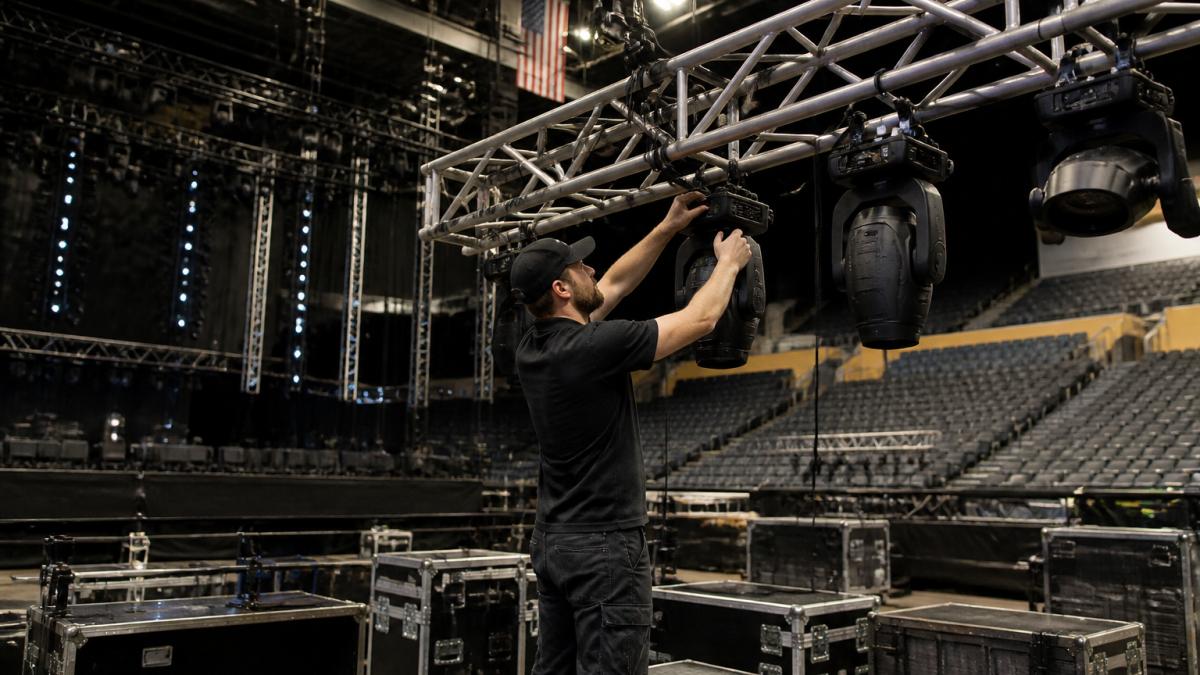
Three details separate a clean show from a rough one. First, fixture placement relative to your stage height and sightlines. Second, power distribution that matches the fixture load without tripping breakers. Third, a lighting operator who knows the cue sequence before doors open, not during the first song.
Staging follows the same logic. Deck height, skirting, and stair placement affect both safety and how the room reads. A stage that's 30 centimeters too low kills sightlines for the back third of the room.
Mapping Your Event Production Timeline From Load-In to Load-Out
An event production timeline works backward from doors, not forward from load-in. Reverse planning is the single biggest difference between a calm show day and a chaotic one.
A workable sequence looks like this:
- Confirm final equipment list and crew call (2 weeks out)
- Verify venue access, power, and rigging (1 week out)
- Load in and build stage (day before or morning of)
- Focus lighting and run sound check (afternoon)
- Doors open, show runs, standby crew on site
- Load out immediately after, or next morning per contract
The mistake most planners make is compressing steps 3 and 4. Build and check need real time. Rushing them pushes problems into the show itself, when you have no room left to fix anything.
What Belongs in an Event Production Proposal Template
A complete event production proposal template includes scope, schedule, equipment list, crew plan, responsibilities, and payment terms. Anything missing from that list becomes a disagreement later.
Use this structure:
- Scope of work: exactly what's included and excluded
- Equipment list: models, quantities, and backups
- Crew plan: roles, call times, and hours
- Timeline: load-in, check, show, load-out
- Responsibilities: who provides power, permits, and security
- Payment terms: deposit, balance, and cancellation policy
- Insurance and liability: certificates and coverage limits
How to Choose the Right Provider for Your Venue and Event Type
Choosing a provider comes down to three questions: can they handle your event size, do they know your venue, and will they own problems on show day?
For smaller corporate events, a multi-discipline provider is usually enough. For concerts or large conferences, you want a partner who manages scheduling, payments, contracts, and on-site crews end to end. AudioBahn Productions works with venues, corporate coordinators, schools, and private hosts across the region, and we've expanded into full logistical support including tents, restroom trailers, and portable laser tag for corporate and school events.
Ask for examples of events similar to yours. A provider who can walk you through a comparable show, in detail, is a provider who has actually done the work.
Conclusion: Getting Production Right the First Time
The real challenge with event production isn't finding equipment. It's finding a partner who coordinates the schedule, the crew, the contracts, and the show-day decisions so nothing falls through the cracks. AudioBahn Productions handles concert sound, stage lighting, staging, and backline, plus full event logistics and portable laser tag, with scheduling, payments, and contract administration managed for you. Get started with AudioBahn Productions and run your next event with one partner instead of five.
Frequently Asked Questions
What services does an event production company provide?
A full-service provider handles audio visual equipment, stage lighting, staging, backline, and on-site technical crews. Many also manage scheduling, contracts, payments, and load-in logistics. For Chicago venues, that often means coordinating with union crews, rigging points, and house AV systems. Some providers now offer additional support like tents, restroom trailers, and portable entertainment such as laser tag for corporate events and school functions.
How do I choose an event production company for a venue?
Start with your event production checklist: confirm the provider has worked in your venue or similar spaces, ask for references from comparable events, and verify they carry liability insurance. Request a sample event production proposal template so you can compare what each provider includes. Ask specifically about crew size, response time if equipment fails, and whether they coordinate with in-house AV teams. A provider that services a wide region can often handle events outside their home base.
How far in advance should I book event production services?
For large concerts or conferences, book six to twelve months ahead, especially in busy seasons. Smaller corporate events and parties can often be booked four to eight weeks out, though equipment availability tightens in peak months. Build your event production timeline backward from the event date and include buffer time for venue walkthroughs, technical rehearsals, and contract review. Earlier booking also gives you more leverage when negotiating scope and scheduling.
Can an event production company coordinate with a venue's in-house AV team?
Yes, and a good provider will insist on it. Before the event, share the venue's technical specs, rigging limits, and power availability with your production partner. Schedule a joint walkthrough so both teams agree on signal flow, microphone placement, and lighting positions. Clear communication prevents the most common failure point: two crews showing up with incompatible gear or conflicting assumptions about who handles what.
Sound, lighting, staging and LED video. Free quote.
Frequently Asked Questions
What services does an event production company provide?
A full-service provider handles audio visual equipment, stage lighting, staging, backline, and on-site technical crews. Many also manage scheduling, contracts, payments, and load-in logistics. For Chicago venues, that often means coordinating with union crews, rigging points, and house AV systems. Some providers now offer additional support like tents, restroom trailers, and portable entertainment such as laser tag for corporate events and school functions.
How do I choose an event production company for a venue?
Start with your event production checklist: confirm the provider has worked in your venue or similar spaces, ask for references from comparable events, and verify they carry liability insurance. Request a sample event production proposal template so you can compare what each provider includes. Ask specifically about crew size, response time if equipment fails, and whether they coordinate with in-house AV teams. A provider that services a wide region can often handle events outside their home base.
How far in advance should I book event production services?
For large concerts or conferences, book six to twelve months ahead, especially in busy seasons. Smaller corporate events and parties can often be booked four to eight weeks out, though equipment availability tightens in peak months. Build your event production timeline backward from the event date and include buffer time for venue walkthroughs, technical rehearsals, and contract review. Earlier booking also gives you more leverage when negotiating scope and scheduling.
Can an event production company coordinate with a venue's in-house AV team?
Yes, and a good provider will insist on it. Before the event, share the venue's technical specs, rigging limits, and power availability with your production partner. Schedule a joint walkthrough so both teams agree on signal flow, microphone placement, and lighting positions. Clear communication prevents the most common failure point: two crews showing up with incompatible gear or conflicting assumptions about who handles what.