The 5 Best Stage Lights for Small Venues and Tight Stages
Last Updated: November 21, 2026
Quick Summary
The best stage lights for small venues are LED PAR wash lights, profile spotlights, Fresnel lights, compact moving heads, and LED light bars. For stages 5 meters wide or less, plan on four to six fixtures: two LED PARs for front wash, two profile spots, and one or two Fresnels for fill.
- Mount front PARs at 8 to 10 feet high and 6 to 8 feet in front of the downstage edge.
- Keep backlight intensity at roughly 60 to 70 percent of front wash so faces stay readable.
- Use RGBW fixtures over plain RGB for cleaner whites on skin tones and video.
- For solo artists, pair one profile spot with one Fresnel for warmth.
- Count DMX channels before buying so you avoid doubling up addresses mid-show.
Table of Contents
- Quick Comparison: 5 Best Stage Lights for Small Venues
- How Many Lights Does a Small Stage Actually Need?
- A Practical Small Venue Stage Lighting Setup
- LED Stage Lights for Small Venues: What the Specs Mean
- Budget Stage Lighting Ideas That Still Look Professional
- Stage Lighting for Bands: Matching the Rig to the Act
- DMX Control and Plug-and-Play Options for Small Stages
- Power, Safety, and Setup Planning Before Show Day
- Frequently Asked Questions
Quick Comparison: 5 Best Stage Lights for Small Venues
Choosing stage lights for small venues comes down to matching fixture type to stage size, not buying the biggest rig you can afford. For most rooms under 5 meters wide, a four-to-six fixture package built around LED PARs, a couple of profile spots, and one or two Fresnels covers front wash and backlight without overwhelming the space (VELLO guide to LED stage lights for small venues).
Here's a shortlist of fixture types, ranked by how well each fits a tight stage.
| Rank | Fixture Type | Best For | Typical Rig Role | Watch Out For |
|---|---|---|---|---|
| 1 | LED PAR wash lights | Front wash and color mixing | 2-4 units across the front | Cheap units with weak dimming |
| 2 | Profile spotlights | Solo artists and podium work | 1-2 units for tight beams | Steep learning curve on focus |
| 3 | Fresnel lights | Soft, even stage coverage | 1-2 units for fill | Bulky for cramped stages |
| 4 | Compact moving heads | Bands wanting movement | 2 units for effects | Noise in quiet rooms |
| 5 | LED light bars | DJs and low ceilings | 1-2 units for backlight | Limited throw distance |
This guide walks through how many lights a small stage actually needs, how to lay them out, and which specs matter once the room gets intimate.
How Many Lights Does a Small Stage Actually Need?
A small stage typically needs four to six fixtures: two LED PARs for front wash, two profile spots for performer visibility, and one or two Fresnels for fill. That's the setup VELLO's stage lighting guide recommends for stages 5 meters wide or less, and it holds up in practice for most club and banquet-room stages.
More lights don't automatically mean a better look. On a tight stage, extra fixtures crowd the truss, add heat, and complicate cabling. Start with the minimum that covers front wash and backlight, then add only when you find a genuine gap.
If you're also sizing sound for the same room, our sound system rentals can help you plan lighting and audio together.
A Practical Small Venue Stage Lighting Setup
A small venue stage lighting setup splits into two jobs: front wash for visibility and backlight for depth. Getting those two layers right makes the stage read as professional even with modest gear.
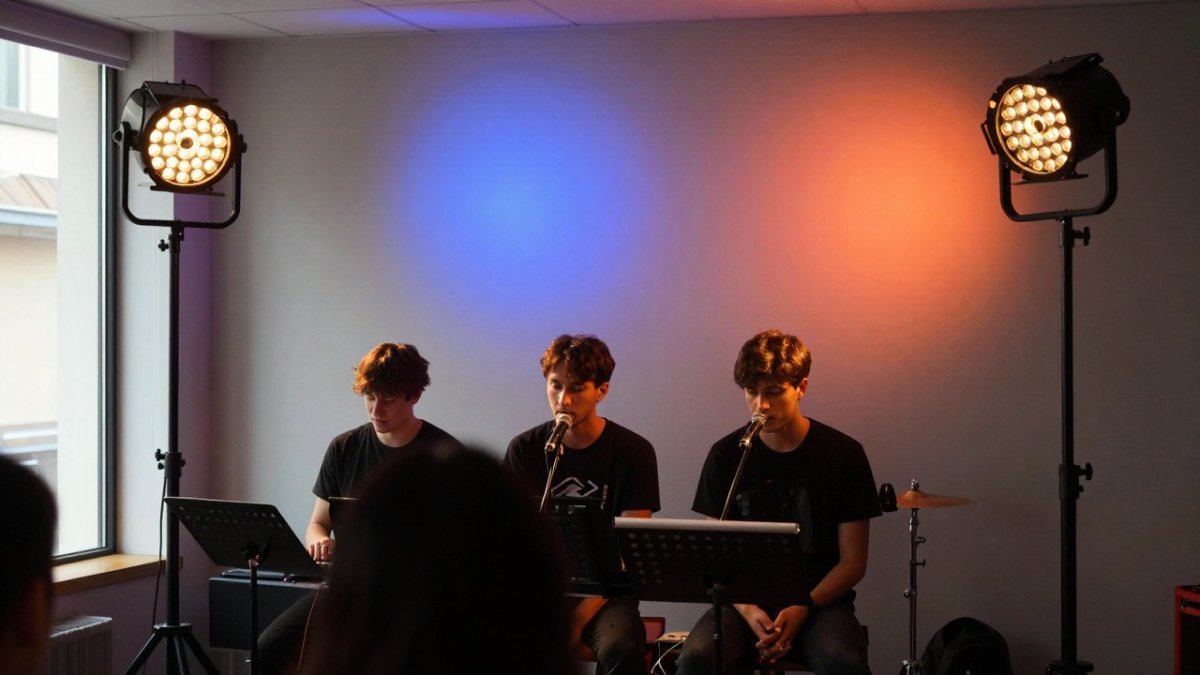
Front Wash and Performer Visibility
Front lighting is non-negotiable. Two LED PARs angled across the stage from the front corners give performers a clean, even wash and keep faces readable from the back of the room.
For a stage roughly 12 to 16 feet wide, mount the front PARs at about 8 to 10 feet high and 6 to 8 feet in front of the downstage edge, angled down at roughly 35 to 45 degrees. That angle lights faces without casting long nose shadows onto the back wall. A 25- to 40-degree beam angle covers a 12-foot-wide stage from that position; a narrower 15- to 25-degree beam is better for a single performer who needs punch from a longer throw.
Watch out: placing front lights too low and too far to the side creates raccoon-eye shadows and lights the back of the performer's head instead of the face. Keep the fixtures high and forward of the performer.
Backlight, Color Wash, and Depth
Backlighting separates performers from the backdrop. A pair of fixtures behind the band throwing color onto the back wall adds depth and energy without blinding anyone. Use a saturated color for the back wall and keep the front wash neutral; the contrast is what makes the stage pop.
Mount backlights 1 to 3 feet behind the upstage line and 8 to 12 feet high, aimed down and slightly toward the back wall rather than at the performers. A 25- to 40-degree beam works for most small stages; a wider wash is fine if the back wall is close. Keep backlight intensity lower than front wash, roughly 60 to 70 percent, so silhouettes read without washing out faces.
Matching the Layout to Stage Size and Ceiling Height
Use these starting points and adjust by eye:
- Stages under 10 feet wide: two front PARs at 8 feet high, one backlight centered, 15- to 25-degree beams.
- Stages 10 to 16 feet wide: two front PARs at 8 to 10 feet high, two backlights, 25- to 40-degree beams.
- Stages 16 to 20 feet wide: four front PARs (two per side) or two PARs plus two profile spots, two to four backlights, 25- to 40-degree beams.
Throw distance matters as much as stage width. A fixture rated for a long throw loses punch up close, and a wide wash mounted far back spills light into the audience. Measure from fixture to performer and pick the beam angle that covers the performer's zone without hitting the front row.
For venues that need a full production package, our live event production service can coordinate lighting, staging, and scheduling.
LED Stage Lights for Small Venues: What the Specs Mean
LED stage lights for small venues live or die on three specs: usable brightness, color quality, and how the fixture behaves in a quiet room. Ignore the marketing wattage and look at what actually reaches the stage.
Brightness, Color Quality, and Usable Output
Brightness isn't just about lumens. Beam angle determines how much of that output lands where you need it. A narrow beam concentrates light for punch; a wide wash covers more stage at lower intensity. For color, RGBW fixtures give cleaner whites than plain RGB, which matters when you're lighting skin tones and video.
Noise, Heat, and Reliability in Intimate Rooms
In a small room, fan noise is audible between songs and heat builds fast. LED fixtures run cooler than older halogen gear, but cheap units still whine. Look for fixtures with quiet fan modes if the stage sits close to the audience. Reliability matters too: a dead fixture mid-set is a visible problem, so keep a spare PAR on hand.
For more on technique and gear, see our live event production blog.
Budget Stage Lighting Ideas That Still Look Professional
Budget stage lighting ideas work best when you spend on the fixtures that do the most visible work. Two good LED PARs beat six cheap ones, because dimming quality and color mixing show up immediately on stage.
A few practical moves that stretch a tight budget:
- Buy fewer, better fixtures and add later
- Use RGBW PARs for both front wash and color effects
- Rent instead of buy for one-off events
Renting is often a practical choice for a single show. You can explore our PA, lighting and wireless mic rentals as an alternative to buying.
Stage Lighting for Bands: Matching the Rig to the Act
Stage lighting for bands depends on the act, not the venue alone. A four-piece rock band wants a wide front wash and strong backlight color. A solo acoustic artist needs a tight profile spot and a soft Fresnel fill, nothing more.
Match the rig to the performance:
- Full bands: two to four PARs for wash, two backlights for color
- Solo artists: one profile spot plus one Fresnel for warmth
- DJs: light bars and compact moving heads for movement
- Corporate and speaking events: clean front wash with a subtle backlight
The mistake we see most is over-lighting a small act. Too many fixtures flatten the stage and distract from the performance.
DMX Control and Plug-and-Play Options for Small Stages
DMX control gives you full command of every fixture from one console, but it isn't the only option. For small stages, the right control choice depends on who is running lights and how repeatable the show needs to be. Here is how the main modes compare.
DMX: Full Control, Real Setup
DMX is the standard for a reason: one controller addresses every fixture, cues can be saved and recalled, and looks stay consistent night to night. A basic DMX controller plus a daisy-chained rig handles most small-venue needs.
Watch out: daisy-chaining more fixtures than the controller's channel count supports forces you to double up addresses, which makes troubleshooting mid-show much harder. Count channels before you buy.
Sound-Active and Standalone Modes
Sound-active mode keeps color moving to the music with zero setup and no operator. It is the fastest path to a lit stage for a solo act or a DJ who wants movement without babysitting a console. The trade-off is control: the lights react to the room's sound, so quiet passages go dark and a loud crowd can trigger unwanted changes.
Foot Controllers and App Control
Foot controllers are a middle ground for solo performers who want to trigger changes between songs without leaving the mic. They typically control a small number of scenes, so plan your looks around the songs where you can spare a tap. App-based control over Wi-Fi or Bluetooth is increasingly common on compact fixtures; it is convenient for setup and small adjustments, but wireless dropouts are a real risk in crowded rooms with heavy phone traffic.
Choosing Control for Your Situation
- No operator, repeatable set: DMX with saved cues, run from a tablet or small console at side stage.
- No operator, one-off or DJ: sound-active mode, with standalone chases as a fallback.
- Solo performer: foot controller for song changes, sound-active for movement between cues.
- Volunteer or inexperienced crew: simple DMX controller with labeled scenes; training the crew on a fixed set of cues beats giving them full control.
We offer a service for training volunteer tech crews, and a free walkthrough and system evaluation to confirm your controller and fixtures are matched before show day.
Power, Safety, and Setup Planning Before Show Day
Power and safety planning prevents the failures that ruin a show.
A pre-show walkthrough catches most problems before doors open. When you're ready to plan the full production, get a free quote for your event.
Small stages punish guesswork and reward planning. If your current rig flickers, overheats, or leaves performers in the dark, it's time for a proper evaluation.
Frequently Asked Questions
What are the best stage lights for a small venue?
For most rooms, a mix of LED PAR wash lights, a couple of compact spotlights for front light, and one or two Fresnels for controlled coverage covers the basics. A stage 5 meters wide or less typically needs 4 to 6 fixtures: two LED PARs, two profile spots, and one or two Fresnels. That mix gives you front wash, backlight, and color without overloading a small rig or a standard wall circuit.
Are LED stage lights bright enough for a small venue?
Yes. Modern LED PAR and spotlight fixtures produce more usable output per watt than older halogen units, and a small room needs far less throw distance. The practical limit is usually control, not brightness: too much raw output on a short throw washes out faces. Dimming, diffusion, and aiming matter more than chasing the highest lumen rating, so match fixture output to your stage depth and ceiling height.
How many lights do you need for a small stage?
Plan on 4 to 6 fixtures for a stage up to about 5 meters wide, split between front lighting and backlight. Wider stages, deeper rooms, or acts that want big color looks need more. Count your circuits before you count fixtures: a small venue stage lighting setup fails more often from power and mounting limits than from too few lights.
What should you avoid when buying stage lights for a small venue?
Avoid buying fixtures with loud cooling fans for quiet rooms, mixing control protocols you cannot operate, and skipping a plan for mounting and power. Also avoid buying one oversized fixture instead of several smaller ones, since coverage and color mixing suffer. If you are unsure what your room needs, get a walkthrough and evaluation of your system before spending, so you upgrade only what is actually missing.

Sound, lighting, staging and LED video. Free quote.
Frequently Asked Questions
What are the best stage lights for a small venue?
For most rooms, a mix of LED PAR wash lights, a couple of compact spotlights for front light, and one or two Fresnels for controlled coverage covers the basics. A stage 5 meters wide or less typically needs 4 to 6 fixtures: two LED PARs, two profile spots, and one or two Fresnels. That mix gives you front wash, backlight, and color without overloading a small rig or a standard wall circuit.
Are LED stage lights bright enough for a small venue?
Yes. Modern LED PAR and spotlight fixtures produce more usable output per watt than older halogen units, and a small room needs far less throw distance. The practical limit is usually control, not brightness: too much raw output on a short throw washes out faces. Dimming, diffusion, and aiming matter more than chasing the highest lumen rating, so match fixture output to your stage depth and ceiling height.
How many lights do you need for a small stage?
Plan on 4 to 6 fixtures for a stage up to about 5 meters wide, split between front lighting and backlight. Wider stages, deeper rooms, or acts that want big color looks need more. Count your circuits before you count fixtures: a small venue stage lighting setup fails more often from power and mounting limits than from too few lights.
What should you avoid when buying stage lights for a small venue?
Avoid buying fixtures with loud cooling fans for quiet rooms, mixing control protocols you cannot operate, and skipping a plan for mounting and power. Also avoid buying one oversized fixture instead of several smaller ones, since coverage and color mixing suffer. If you are unsure what your room needs, get a walkthrough and evaluation of your system before spending, so you upgrade only what is actually missing.